
Turkish Trade Compatible Lines
High-Spec Baby Hosiery: Priority Factory Production
Engineered for infant dermatological protection, thermal equilibrium, and rigorous EU/US compliance standards. Direct wholesale configurations ready for private label integration.
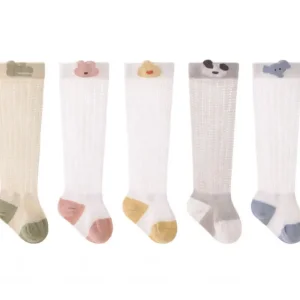
Thin Combed Cotton Knee-High Mosquito Protection Infant Socks - Export Grade
View Technical Specifications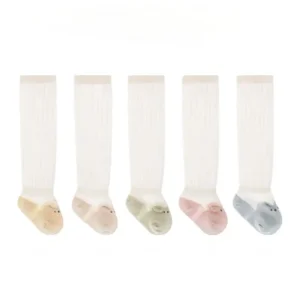
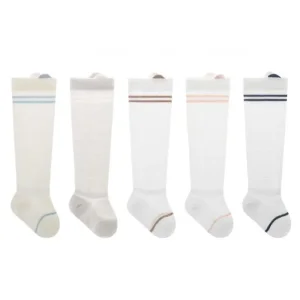
Thermal Regulation Cartoon Infant Knee-High Socks - Aegean Market Sourcing
View Technical Specifications
100% Certified Organic Cotton Newborn Knee-High Socks with Zero Chemical Dyes
View Technical Specifications
Industrial Ecosystem Intelligence
The Turkish Hosiery Manufacturing Landscape & Global Strategic Context
An empirical assessment of the manufacturing corridors across Istanbul, Denizli, Bursa, and Gaziantep, evaluating trade agreements, lead-time velocity, and material origins.
Geographic Proximity & Speed
Turkey occupies an indispensable geographic apex connecting the European Union, the United Kingdom, and Middle Eastern retail conglomerates. For international procurement managers, Turkish hosiery facilities offer an unmatched lead-time advantage:
- 3 to 7 days transit overland across Western and Central Europe via TIR networks.
- Elimination of 35-day maritime canal bottlenecks typical of Far East freight lines.
- Zero-tariff preferential treatment under the EU-Turkey Customs Union (A.TR movement certification).
Regional Industrial Specialization
Turkey ranks globally as the second or third largest exporter of knitted socks, with specialized industrial corridors optimizing distinct manufacturing disciplines:
- Istanbul (İkitelli & Beylikdüzü): High-density automated single/double cylinder knitting and finishing hubs.
- Denizli & Aegean Basin: Renowned for GOTS-certified organic cotton spinning and hypoallergenic dyeing.
- Gaziantep: Synthetic core-spun yarns, recycled polyester, and specialized elastomeric texturing.
Global Strategic Synthesis
Modern retail giants utilize dual-sourcing strategies. While Turkey provides rapid responsiveness and small-to-mid batch agile reorders, massive capacity hubs provide baseline global inventory:
- Hybrid manufacturing structures combining Turkish trade routes with tier-1 Asian engineering lines.
- Shared technological architectures: Italian Lonati and Sangiacomo computerized machinery.
- Unified compliance portfolios across BSCI, Sedex SMETA, and OEKO-TEX Standard 100.
#2
Global Exporter Ranking in Knitted Hosiery
2.2B+
Pairs Produced Annually in Key Turkish Hubs
< 72h
Transit Window to Southern European Distribution Centers
100%
REACH & OEKO-TEX Class 1 Chemical Compliance
Technical Manufacturing Standard
Engineering Specifications for Baby Hosiery: Safety, Yarn & Ergonomics
Infant socks require specialized engineering protocols far exceeding adult footwear metrics. Below are the precise technical benchmarks required by top-tier global retailers.
Infant Tourniquet Syndrome Prevention
The primary safety hazard in pediatric hosiery is Hair/Thread Tourniquet Syndrome, caused by loose internal jacquard floating threads wrapping around infant toes. Our manufacturing protocol implements mandatory structural defenses:
- Inverted Loop & Sandwich Knitting: All auxiliary pattern threads are secured between the internal face yarn and outer ground yarns, eliminating exposed floats.
- True Seamless Hand-Linking: Replacing standard abrasive Rosso seams with computerized loop-to-loop linking to eliminate pressure ridges against sensitive metatarsals.
- Low-Tension Rib Cuffs: Hydrostatic cuff retention calibrated under 6–8 mmHg to ensure socks remain on moving infants without impeding peripheral microcirculation.
Non-Toxic High-Grip Silicone Formulations
For developmental crawling, standing, and early walking phases, anti-slip tread stability is essential. We utilize medical-grade liquid organosilicon polymers screen-printed and heat-cured under continuous environmental controls:
- Zero Plasticizers: 100% free of phthalates (DEHP, DBP, BBP, DINP, DIDP, DNOP), BPA, and heavy metal cross-linking catalysts.
- High Wash-Cycle Shear Adhesion: Tested under ISO 6330 laundering protocols (40°C wash and tumble dry) for 50+ consecutive cycles without tread detachment.
- Ergonomic Balance Zoning: Grip arrays engineered specifically along the calcaneus (heel) and first metatarsal head to stabilize gait velocity.
| Age Bracket / Size | Needle Count (Gauge) | Recommended Yarn Blend | Cuff Construction | Primary Safety Focus |
|---|---|---|---|---|
| Preemie / Newborn (0-3M) | 96N to 108N (Super Fine) | 100% Organic Aegean Combed Cotton + Spandex core | Fold-over roll welt (Non-binding) | Zero internal thread floats; hand-linked toe seams. |
| Infant (3-12M) | 120N to 132N (High Density) | 80% Combed Cotton / 17% Polyamide / 3% Elastane | Double-welt ribbed elastic | Elastic retention balance; anti-chew grip curing. |
| Toddler / Walker (12-24M) | 132N to 144N (Durable Mesh) | 78% Bamboo Viscose / 20% Nylon / 2% Lycra | Mid-crew ribbed compression zone | Full-sole anti-slip coefficient of friction (COF > 0.6). |
| Early Childhood (2-4Y) | 144N to 168N (Reinforced) | 75% Organic Cotton / 22% Polyester / 3% Spandex | Ankle/Quarter low-cut sport cuff | Heel and toe reinforced loop terry cushioning. |
Procurement Strategy
Overcoming Global Sourcing Bottlenecks in Baby Sock Manufacturing
Strategic analysis for enterprise retail procurement teams navigating margin compression, raw material volatility, and rigorous consumer safety enforcement.
Yarn Cost & Exchange Volatility
Fluctuations in the Turkish Lira (TRY) alongside global New York ICE cotton futures can present budgeting challenges. Tier-1 enterprise procurement teams counteract these swings through structured strategies:
- EUR/USD Denominated Long-Term Contracts: Locking forward yarn prices 6–12 months in advance to hedge localized inflationary volatility.
- Hybrid Scaled Manufacturing: Leveraging mega-capacity sister factories in China (200M+ pairs/year) for foundational base volume and Turkish lines for fast reorders.
Regulatory Compliance Rigor
Baby hosiery faces scrutiny from customs authorities and consumer safety commissions worldwide. Shipments must arrive with complete verification documentation:
- EU REACH Annex XVII: Stringent restrictions on azo colorants, polycyclic aromatic hydrocarbons (PAHs), and organic tin compounds.
- US CPSIA Section 101/108: Total lead content under 90 ppm, total phthalate screening, and tracking label trace requirements.
- OEKO-TEX Standard 100 Annex 6 (Product Class 1): Verification for baby articles up to 36 months of age.
Automated Quality Assurance
Manual checks are insufficient for pediatric items. Our production facilities maintain rigorous automated quality control protocols:
- Dual-Head Metal Detection: Every individual sock passes through 9-point conveyor needle detectors calibrated to detect broken needles ≤0.8 mm.
- Colorfastness to Saliva & Sweat: Laboratory testing under ISO 105-E04 guaranteeing zero dye migration into infant mucous membranes.
Future-Ready Engineering
Technological Roadmap: The Evolution of Intelligent Baby Hosiery
How automation, bio-fabricated textiles, and digital quality monitoring are reshaping infant hosiery manufacturing over the next five years.
Phase 1: Sustainable Raw Materials & Circular Processing
By 2026, over 60% of European and North American apparel buyers will mandate circularity proofs. Our supply lines are pioneering transparent sustainable sourcing:
- Traceable Aegean Organic Cotton: Molecular marker technology verifying authentic organic cultivation from Turkish and certified international fields.
- Bio-Degradable Elastomers: Replacing traditional petro-chemical spandex with bio-derived polyurethane fibers that break down within 5 years in active compost.
- Natural Botanical Dyestuffs: Dyeing processes utilizing vegetable extracts, madder root, and pomegranate rind, requiring 70% less water and zero heavy metals.
Phase 2: Robotic Production & AI-Guided Vision Inspection
Knitting mills are shifting toward fully dark factory configurations where human error is engineered out of critical pediatric production stages:
- Automated Robot-Arm Linking: Sangiacomo and Lonati closed-toe machines eliminating manual sewing stations and eliminating dropped stitch vulnerabilities.
- High-Speed Vision AI Defect Detection: Real-time 360-degree optical scanning identifying tension irregularities, dropped loops, or microscopic thread deviations at line speed.
- Intelligent Anti-Slip Dotting: Computerized micro-dispensing systems adjusting silicone viscosity and droplet volume dynamically across varied yarn tensions.
Wholesale Inventory Catalog
Certified Baby Socks Catalog for Direct Wholesale & OEM Sourcing
Explore production-ready baby sock designs, toddler grip arrays, and novelty infant lines engineered for immediate brand customization and fast factory dispatch.
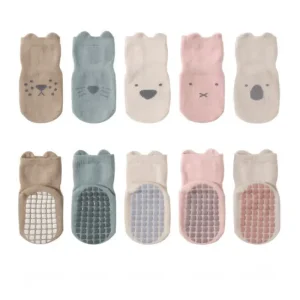
Wholesale Non-Slip Infant Socks with Cute Novelty 3D Cartoon Characters
View Technical Specifications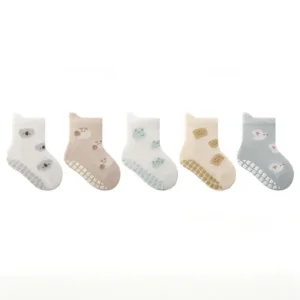
Summer Breathable Mesh Anti-Slip Newborn & Toddler Walking Socks
View Technical Specifications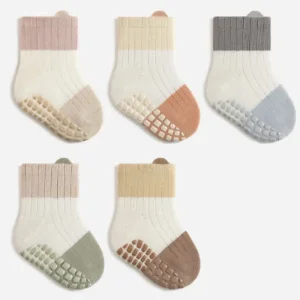
Indoor Floor High-Friction Anti-Slip Baby Grip Socks - Custom Colorways
View Technical Specifications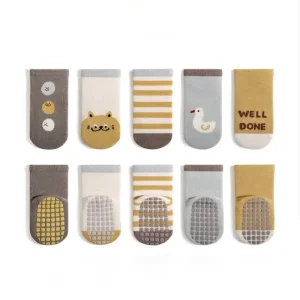
Factory Direct Mid-Tube Fall Infant Socks with Anatomical Floor Grips
View Technical Specifications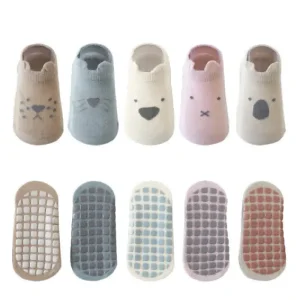
Newborn Pure Cotton Crew Socks with Heat-Fused Silicone Grip Tread
View Technical Specifications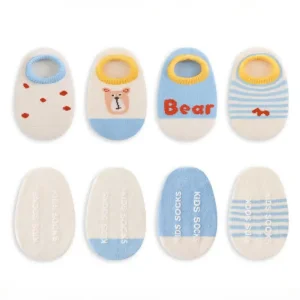
Soft Combed Cotton Ankle Baby Socks with Ergonomic Elastic Banding
View Technical Specifications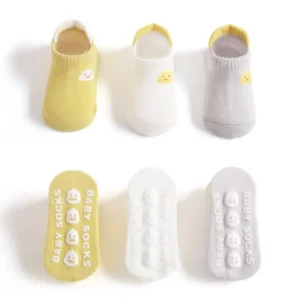
Low-Cut Anti-Slip Toddler Ankle Socks for High-Volume Retail Programs
View Technical Specifications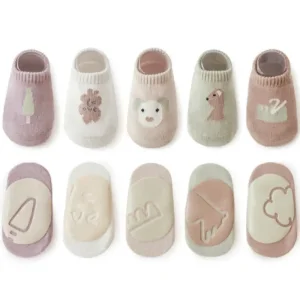
High-Traction Walking Stage Toddler Crew Socks with Textured Animal Motifs
View Technical Specifications
Procurement Advisory
Frequently Asked Questions: Baby Sock Manufacturing & Wholesale Supply
Essential guidance on lead times, factory audits, test certifications, MOQs, and hybrid sourcing solutions.
What is the typical Minimum Order Quantity (MOQ) for custom baby socks?
For custom yarn dyeing, specific pantone jacquard knitting, and custom silicone grip tooling, typical production MOQs begin at 1,200 to 2,400 pairs per design across 3–4 size breakdowns. For standard inventory colorways requiring custom brand packaging or localized transfer printing, programs can begin at 500 pairs per SKU.
How do Turkish factories compare to Chinese production hubs for baby socks?
Turkey excels in rapid turnaround, geographical proximity to European/Middle Eastern distribution corridors (3–7 days via road freight), and duty-free access into the EU via the ATR certificate. China delivers unmatched scale, highly cost-efficient mega-volume output (over 200M pairs annually), and advanced synthetic fiber development. Many top brands maintain a diversified dual-sourcing model leveraging both regions.
What certifications are required to import baby socks into the EU and US?
For the European Union, imports require compliance with REACH Annex XVII (banned amines from azo dyes, nickel release, organostannic compounds), and OEKO-TEX Standard 100 Class I (infants). For the United States, socks must comply with CPSIA regulations, including total lead content ≤90 ppm, 16 CFR Part 1610 (flammability), and mandatory tracking labels on packaging.
How are silicone anti-slip grips tested for pediatric safety?
Silicone soles undergo comprehensive chemical toxicology testing to verify zero phthalate, BPA, and latex compounds. Mechanically, they undergo torque, tensile peel, and repeated wash tests (ISO 6330) up to 50 cycles to verify that silicone dots or logos do not detach, eliminating choking hazards.
What is the standard production lead time from tech pack to port delivery?
Digital pattern rendering and physical sample prototyping generally take 5 to 7 working days. Once pre-production samples are approved, bulk cylinder knitting, automated toe closing, silicone curing, and retail packaging require approximately 20 to 30 days, depending on batch volume and custom packaging complexity.
What social compliance audits do our partner facilities maintain?
Our production ecosystems and verified manufacturing partners operate with BSCI (Business Social Compliance Initiative), Sedex SMETA 4-Pillar, and ISO 9001 certifications. These frameworks verify fair working conditions, zero child labor, fair living wages, and documented environmental controls.
Ready to Scale Your Baby Sock Sourcing Pipeline?
Whether benchmarking Turkish manufacturing corridors or expanding high-volume private label programs, our technical engineering team provides detailed sample kits, yarn lab-dips, and FOB/DDP quotes within 24 business hours.