
Kenya Commercial Benchmark Baby Hosiery Line
Engineered for high-volume wholesale distribution through Eastleigh, Kamukunji, and tier-one retail grocers across Nairobi and Mombasa. High tensile strength, zero-formaldehyde organic cotton blends.
The Kenyan Infant Apparel Landscape: Strategic Commercial Realities
Navigating demographic expansion, modern retail evolution, and the shift from second-hand textiles (Mitumba) to factory-certified primary goods.
Kenya's Demographic Dividend & Urban Middle-Class Expansion
With an annual population growth exceeding 1.9% and a median age below 20 years, the Republic of Kenya presents one of the most dynamic pediatric consumption curves in sub-Saharan Africa. The rising urbanization around the Nairobi Metropolitan Area, Mombasa, Kisumu, Nakuru, and Eldoret has fostered an aspiring consumer segment that prioritizes specialized, skin-friendly, and durable infant apparel.
Historically dominated by unorganized open-air markets and bulk importation of used garments (Mitumba), the infant sock segment is undergoing a rapid formalization. Heightened maternal awareness regarding dermatological sensitivity, coupled with increasing institutional deliveries across private and public healthcare facilities, has fueled demand for sealed, hygienic, factory-direct infant footwear that guarantees zero chemical contaminants.
Distribution Topography: From Eastleigh to Modern FMCG Retail
A resilient import strategy requires an understanding of Kenya's dual-channel distribution architecture:
- The Wholesale Trading Hubs: Eastleigh (particularly BBS Mall and traditional commercial complexes) and Kamukunji in Nairobi serve as the epicenter for sub-Saharan redistribution, channeling container loads into Western Kenya, Uganda, Rwanda, and South Sudan.
- Organized Supermarket Chains: Modern tier-one grocers including Naivas, Quickmart, and Carrefour Kenya demand standardized EAN barcoding, localized hangtags, retail-ready clip-strip packs, and stringent KEBS (Kenya Bureau of Standards) compliance.
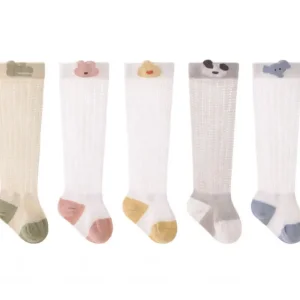
- Digital Commerce & Social Retailing: Rapid penetration of M-Pesa mobile money has spawned hundreds of independent e-commerce baby boutiques across Instagram and Jumia requiring agile, pre-packed wholesale bundles with diverse cartoon SKUs.
Supply Chain Insight for East African Buyers: Sourcing direct from China Factory 4.0 infrastructure eliminates intermediaries, compressing landed costs at the Port of Mombasa by 22% to 35% compared to purchasing through third-party regional traders in the Middle East. Furthermore, factory-direct private labeling empowers local Kenyan brands to build defensible brand equity in the East African Community (EAC).
Pediatric Engineering Roadmap for Tropical East African Climates
Developing infant hosiery suited for dual wet/dry seasons, high humidity coastal corridors, and unpaved domestic surfaces.
Anti-Slip Viscosity Silicone Chemistry
Unlike budget PVC print adhesives that harden and detach after several wash cycles in borehole water, our proprietary medical-grade silicone grip compound retains tensile grip up to 60 washings. Precision engineered with micro-dot arrays across the metatarsal and calcaneus zones to safeguard toddlers learning to walk on polished terrazzo, smooth tile, and concrete flooring common in Kenyan urban homes.
Zero-Pressure Comfort Elasticity Cuff
Infant lymph circulation is fragile. We engineer our cuffs with dual-wrapped inverted spandex filaments knitted under automated tension-control feeding. This prevents constrictive marks on chubby infant ankles while retaining structural memory to prevent socks slipping into shoes during active movement in daycare centers.
Hand-Linked Seamless Rosso Toe Finish
Conventional automated socks use standard overlock stitching which leaves a bulky, coarse seam ridge across the toes—the primary cause of friction blister formation in newborns. Our production lines feature Italian automated hand-linking simulation units that render the toe seam flat, continuous, and completely frictionless.
| Yarn Architecture | Technical Composition | Tensile Performance | Moisture Vapor Transmission | Recommended Kenyan End-Use |
|---|---|---|---|---|
| Grade-A Combed Organic Cotton | 80% Combed Cotton / 17% Nylon / 3% Spandex | High ring-spun strength, zero pilling under 50 cycles | High vapor diffusion (850g/m²/24hr) | Daily wear in dry inland climates (Nairobi, Nakuru, Rift Valley) |
| Regenerated Bamboo Fiber | 75% Bamboo Viscose / 20% Polyester / 5% Elastane | Ultra-soft natural drape, bacteriostatic index >92% | Extreme hygroscopic uptake (fast evaporation) | Humid tropical coastal belts (Mombasa, Malindi, Diani) |
| Terry-Cushioned Thermal Blend | 82% Cotton / 15% Polypropylene / 3% Spandex | High loop-density sole for shock absorption | Balanced thermal insulation (R-value 0.18) | Cold high-altitude regions (Eldoret, Limuru, Nyeri, Aberdares) |
| Insect-Defensive Lightweight Mesh | 70% Mercerized Cotton / 28% Nylon / 2% Spandex | Ultra-fine 168N knit, snag-resistant micro-porosity | Maximum airflow matrix (1200g/m²/24hr) | Evening outdoor and suburban semi-rural protection against vectors |
Navigating KEBS, PVoC, and East African Border Clearance
Ensuring risk-free import operations with pre-export documentation that complies with Kenya TradeNet guidelines.
Pre-Export Verification of Conformity (PVoC)
The Kenya Bureau of Standards (KEBS) mandates that all textile and apparel consignments entering Kenya must undergo strict inspection prior to departure at the country of origin. Without a valid Certificate of Conformity (CoC), consignments are subject to a 15% destination inspection penalty, prolonged demurrage charges at the Kilindini Harbour in Mombasa or the Inland Container Depot Nairobi (ICDN), or mandatory re-exportation.
As an experienced global OEM/ODM manufacturer, we streamline the entire PVoC pathway with certified inspection agencies (SGS, Intertek, Bureau Veritas, CCIC) directly at our factory before packing containers.
Eco-Toxicological & Physical Testing Standards
Our baby sock production lines operate under strict conformance to KS EAS 253:2018 (East African Standard for Infant Hosiery) and international benchmarks including OEKO-TEX Standard 100 (Class I for Infants):
- Formaldehyde Levels: Undetectable (<16 ppm limit), preventing pediatric dermatitis.
- Azo Dyes & Heavy Metals: 100% free from carcinogenic aryl amines and extractable lead/cadmium in silicone grips.
- Color Fastness: Grade 4-5 fastness against saliva, perspiration, and mechanical rubbing.
- Dimensional Stability: Less than 3% shrinkage across prolonged warm water washing.
Need Seamless KEBS PVoC Certification for Your Shipment?
Our experienced export compliance team prepares third-party lab tests, IDF (Import Declaration Form) documents, and CoC issuance directly from our facility.
Industrial Resilience: Inside MiFo's 42,000m² Production Engine
Transforming yarn filaments into retail-ready hosiery with computer-controlled precision, automated batch tracking, and zero defect tolerance.
Computerized Knitting Fleet
Housing over 500 state-of-the-art Italian single and double-cylinder computerized knitting machines (Lonati and Sangiacomo calibrated). Capable of multi-gauge shifts (96N, 108N, 120N, 144N, 168N) with sub-millimeter needle precision to execute intricate cartoon jacquards without loose reverse-side threads that could tangle infant toes.
Scale-Driven Cost Efficiencies
By consuming over 10,000 metric tons of raw combed cotton and functional synthetic fibers annually, our upstream purchasing power yields yarn cost reductions of 12-18% compared to boutique manufacturers. This cost advantage is passed directly to Kenyan volume importers, providing healthy retail and wholesale margins.
Ethical Compliance: BSCI & Sedex
Certified under both BSCI (Business Social Compliance Initiative) and Sedex SMETA 4-Pillar audits. Transparent labor governance, zero child labor, green energy integration, and comprehensive effluent treatment (ETP) ensure your brand is protected against supply-chain compliance scrutiny.
End-to-End Agile Order Orchestration for East Africa
B2B Procurement Framework: Landed Cost Optimization & Container Logistics
Strategic logistics planning for FCL/LCL ocean cargo and air consolidations serving Nairobi, Mombasa, and regional East African hubs.
FOB, CIF, and DDP Delivery Modes Compared
Choosing the right Incoterm drastically impacts capital utilization when importing hosiery into Kenya:
- FOB (Free On Board) China Ports: Preferred by seasoned Kenyan importers who maintain corporate forwarder accounts with shipping lines (Maersk, CMA CGM, PIL, COSCO) providing direct calls to Mombasa.
- CIF (Cost, Insurance & Freight) Mombasa: Ideal for mid-sized wholesale distributors who want shipping costs managed by the factory directly to Kilindini Harbor.
- DDP (Delivered Duty Paid) Nairobi Clearing: Tailored for emerging e-commerce brands and retailers who require end-to-end clearing, customs duty settlement, and direct transport to warehouses in Industrial Area, Westlands, or Eastleigh.
Cube Optimization & Moisture-Proof Sealing
Transiting tropical maritime routes through the Indian Ocean exposes containerized cotton goods to condensation ("container rain"). Our packing methodology incorporates:
- Double Heavy-Gauge Poly Liners: Hermetically sealed outer master carton bags shielding against salt air and ambient moisture.
- High-Absorption Clay Desiccants: Maintaining internal relative humidity below 45% throughout the 22-day maritime journey from China to Mombasa.
- High-Density Compression Packing: Maximizing pair count in 20GP (approx. 180,000–220,000 pairs) and 40HQ (approx. 450,000–520,000 pairs) containers, minimizing freight cost per pair.
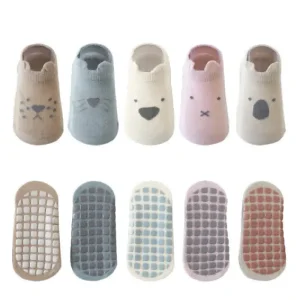
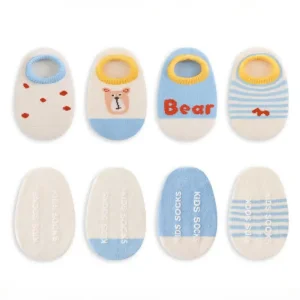
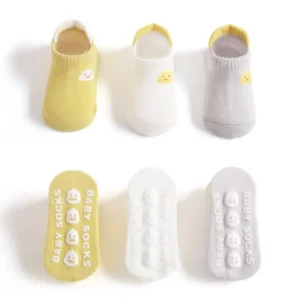
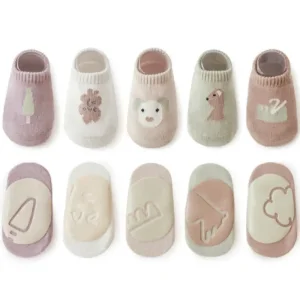
Comprehensive Infant & Toddler Hosiery Collections
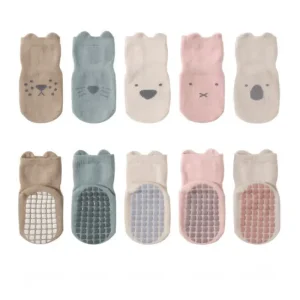
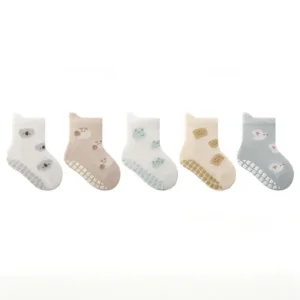
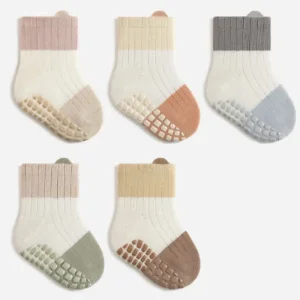
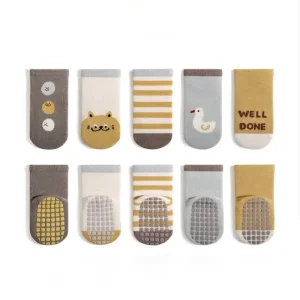
Factory-direct inventory solutions engineered with anti-slip silicone, reinforced wear points, and custom private-label branding for the Kenyan market.
Technological Roadmap: The Next Era of Sustainable Infant Footwear
Aligning with circular economic policies and modern global consumer preferences across emerging markets.
Botanical Dye Systems
Transitioning beyond heavy petrochemical synthetic pigments toward natural, herbal, and plant-derived dyeing technologies (including tea tree extract, gardenia, and onion peel extracts). These zero-effluent colorants eliminate chemical runoff while keeping delicate infant skin free from allergenic residues.
Recycled Regenerated Cotton (GRS)
Certified by the Global Recycled Standard (GRS), our recycled cotton yarn blends convert pre-consumer spinning waste into durable, soft yarns. This conserves up to 70% of process water, offering an attractive sustainability talking point for environmentally conscious retailers across East Africa.
Thermoregulating Functional Yarns
By blending micro-denier hollow-core polyester and natural combed cotton, our seasonal lines achieve intelligent temperature balance—dissipating excessive heat during warm equatorial afternoons and trapping body heat during cool morning school runs.
Frequently Asked Questions for Sourcing Baby Socks to Kenya
In-depth responses covering custom design, minimum order quantities, KEBS certification, shipping routes, and private labeling.
What are your Minimum Order Quantities (MOQ) for custom branded baby socks shipped to Kenya?
Our baseline factory MOQ begins at 1,000 pairs per design/colorway, spanning up to 3 age-graded sizes (e.g., 0-6M, 6-12M, 12-24M). For established retail chains or wholesale distributors consolidating full 20GP or 40HQ containers destined for Mombasa or ICDN Nairobi, we offer multi-SKU consolidation, allowing you to combine 20 to 50 distinct jacquard designs within a single container order to balance your inventory turnover.
How do you handle the KEBS Pre-Export Verification of Conformity (PVoC) process?
We take complete operational ownership of the physical testing and inspection coordination in China. Once your production run is finished, we partner with designated inspection bodies (such as SGS, Intertek, or Bureau Veritas) to conduct random batch sampling, test against KS EAS 253:2018 parameters, and submit the final inspection report to generate the official Certificate of Conformity (CoC). This ensures smooth customs clearance through the Kenya TradeNet portal without destination delays.
Can you customize retail-ready packaging with barcodes and Swahili / English text?
Yes. We offer comprehensive private-label packaging options, including branded header cards, belly bands, multi-pair gift boxes, and eco-friendly frosted zip-lock pouches. Our in-house packaging studio prepares artwork incorporating your brand logo, EAN-13 barcodes, size charts, care instructions, and dual-language labeling (English and Swahili) to comply with local trade guidelines and retail requirements across supermarkets like Naivas and Quickmart.
What is the typical lead time from design approval to delivery in Nairobi?
The standard development workflow involves: (1) Technical pattern creation and digital CAD proofs within 24–48 hours; (2) Physical pre-production sample knitting within 5–7 working days; (3) Bulk industrial knitting and silicone grip processing in 20–25 days; (4) PVoC inspection and container loading in 3–5 days. Ocean transit from Ningbo/Shanghai/Shenzhen ports to the Port of Mombasa typically requires 18–24 days, followed by 2–4 days rail transit along the Standard Gauge Railway (SGR) to the Nairobi Inland Container Depot.
Are your baby socks safe for sensitive newborn skin and tropical heat?
All our baby hosiery lines are produced using 100% premium long-staple combed cotton or natural bamboo rayon yarns certified under OEKO-TEX Standard 100 (Class I). They are completely free from toxic heavy metals, organotin compounds, phthalates, and formaldehyde. The knitting utilizes an open-loop breathable mesh weave across the instep to facilitate continuous air circulation, preventing skin friction and heat rashes in tropical East African conditions.
How do we get started with custom samples or receive your complete hosiery catalog?
You can begin by contacting our enterprise export team via email at [email protected], by telephone at +86 185 8366 1013, or directly via WhatsApp at +86 131 9869 8233. Share your desired product category, yarn preferences, size profile, and quantity targets to receive our technical portfolio, physical sample swatches, and a customized FOB/CIF quotation within one working day.
Launch Your High-Margin Baby Sock Line in Kenya
Connect directly with China's premier hosiery manufacturing group. Certified quality, stable production scheduling, and verified KEBS/PVoC export support for East African businesses.