
Featured Infant & Toddler Sock Lineup for Regional Distribution
Precision-knitted with combed organic ringspun fibers, optimized for cross-border transit and strict pediatric consumer safety standards.
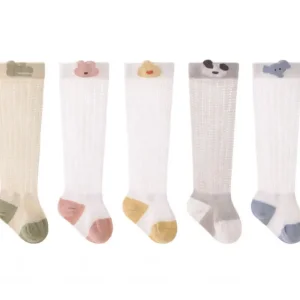
Custom Long Tube Breathable Seamless Infant Socks (Mexico Market Line)
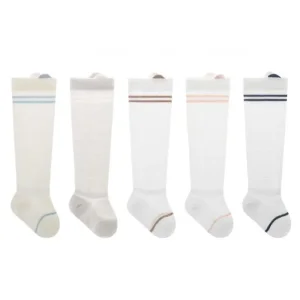
Thin Cotton Knee-High Mosquito Protection Baby Socks (Nearshore Supply)
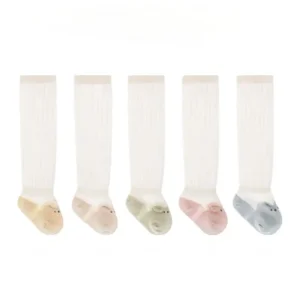
Cooling Breathable Cartoon Infant Knee-High Hosiery for Private Label
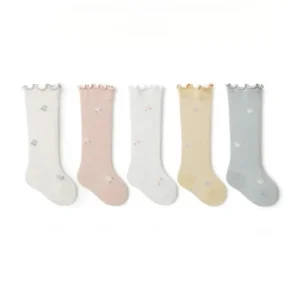
Eco-Friendly Pure Organic Cotton Baby Knee-High Socks (USMCA Compliant)
The Mexican Commercial Landscape for Custom Baby Socks Manufacturing
Navigating regional production corridors, nearshoring advantages under USMCA/T-MEC, and the evolving dynamics of Latin American hosiery fabrication.
The global juvenile apparel sector has encountered radical structural transformations over recent procurement cycles. With international supply chains pivoting aggressively toward nearshoring, Mexico has emerged as an indispensable hub for high-volume custom infant hosiery. Geographically positioned at the nexus of the Americas, Mexican manufacturing corridors—spanning the historically prominent textile regions of Puebla, Tlaxcala, and the Bajío cluster in Guanajuato, extending upward to border industrial hubs such as Ciudad Juárez, Monterrey, and Tijuana—offer distinct operational efficiencies for global enterprise buyers.
Procuring baby socks is inherently more technologically demanding than adult fashion socks. Infant and newborn skin is three times thinner and significantly more sensitive to chemical contaminants, mechanical shear, and elastic constriction. Consequently, procurement officers from major US and Latin American retailers are progressively establishing production lines within or alongside Mexican manufacturing infrastructure to leverage USMCA (United States-Mexico-Canada Agreement) duty-free tariff benefits while enforcing rigid, real-time quality control checks.
In contrast to traditional maritime freight routes from East Asia—which routinely introduce 35 to 55 days of maritime transit, erratic canal bottlenecks, and acute exposure to Section 301 tariffs—sourcing via certified Mexican manufacturing agreements allows containerized dry-van or intermodal freight to dock at Texas, California, and Arizona logistics gateways within 72 to 120 hours. This agility enables retail merchandisers to compress inventory buffer stocks, execute precise in-season reorders for seasonal infant patterns, and maintain flawless fill rates across fast-moving SKU variations.
| Evaluation Parameter | Mexican Nearshore Factory Pipeline | Traditional East Asian Seaborne Model | Procurement Impact |
|---|---|---|---|
| Lead Time to US / CA Gateways | 3 to 7 Days Over-the-Road | 35 to 50 Days Seaborne + Port Drayage | Minimizes warehouse safety stock requirements by up to 40%. |
| Tariff / USMCA Qualification | Duty-Free (Under Yarn-Forward Rule) | Variable Tariffs (Often 7.5% - 25% + Ad Valorem) | Eliminates landed margin erosion directly at customs entry. |
| Pediatric Testing & Compliance | Pre-validated NOM-004, CPSIA, and ASTM F963 | Batch testing required per sea shipment | Drastically mitigates FDA/CPSC port-of-entry seizure risk. |
| Carbon Footprint (Scope 3 GHG) | Low (Direct overland highway/rail routes) | High (Intercontinental heavy-fuel bunker shipping) | Aligns with Fortune 500 corporate ESG supply disclosures. |
Global Compliance Mandates: NOM, CPSIA, and OEKO-TEX Class I
How enterprise-scale infant hosiery manufacturing resolves chemical, mechanical, and dermatological hazards before distribution.
Dermal Biocompatibility
Full conformance with OEKO-TEX Standard 100 Class I (infants up to 36 months). Elimination of carcinogenic azo dyes, extractable heavy metals, organotin compounds, and chlorophenols. Ensures pH compatibility precisely matching delicate infant skin (5.5–6.5).
Phthalate-Free Gripper Adhesion
Application of liquid silicone rubber (LSR) or medical-grade polymer micro-dots formulated without DEHP, DBP, BBP, DINP, or DIDP. Anti-slip configurations withstand 50+ commercial wash-dry cycles without micro-cracking, flaking, or posing choking hazards (16 CFR 1501).
Toe-Tourniquet Prevention
Automated hand-linking or seamless Ross-loop closure technology eliminates interior thread loops. Conventional looped seams present severe risk of infant toe strangulation (hair/thread tourniquet syndrome), an absolute failure vector for institutional buyers.
Mexican NOM-004-SCFI-2006 & CPSC Dual Qualification
Navigating cross-border trade between Mexico and the United States necessitates total alignment with Mexican Official Standards (Normas Oficiales Mexicanas). Specifically, NOM-004-SCFI-2006 dictates commercial information, labeling on textile products, garments, and accessories. Custom baby socks intended for retail in Mexico or bilateral distribution must specify precise fiber percentages, commercial brand registration, laundering instructions in Spanish, and country of origin identifiers with wash-resistant heat transfer or sewn-in soft satin tags.
Simultaneously, shipments moving northbound into the United States must strictly satisfy the Consumer Product Safety Improvement Act (CPSIA) and 16 CFR Part 1610 (Standard for the Flammability of Clothing Textiles). By engineering socks utilizing non-combustible combed cotton matrices, low-profile Lycra spandex, and certified lead-free pigment dyes (lead content strictly below 90 ppm), our OEM industrial facilities ensure seamless pass-through across both SAT (Servicio de Administración Tributaria) customs checkpoints and US Customs and Border Protection (CBP) cargo inspections.
Technical Knitting Specifications: Cylinders, Needles & Polymers
From 96N chunky newborn terry to 200N high-density infant gauges: how automated Italian and South Korean machines achieve micrometer-level fit consistency.
The manufacturing architecture for custom infant and baby socks diverges fundamentally from standard hosiery lines due to the anatomical geometries of pediatric feet. An infant foot possesses a significantly higher ratio of subcutaneous adipose tissue, a low dorsal arch profile, and an accelerated sweat gland density per square centimeter compared to adults. To engineer baby socks that remain secure without restricting venous micro-circulation requires computerized multi-gauge cylinder selection and specialized tension feeds.
96N to 108N Low Cylinder
Primary Application: 0-6 Month Newborn Booties & Winter Plush Terry.
Utilizes heavier count combed cottons (21S/2 or 32S/2 double-ply). Ideal for thermal insulation, cushion sole beds, and gentle-touch hospital nursery roll-cuffs without tight elastic tension.
144N Standard Cylinder
Primary Application: 6-18 Month Crawling & Pre-Walker Socks.
The global gold-standard benchmark balancing yarn weight with jacquard graphic fidelity. Accommodates 32S/1 or 40S/1 combed ringspun yarns with 20D/75D spandex cores for elastic recovery.
168N to 200N High Gauge
Primary Application: 18-36 Month Toddler First-Walkers & Fine Dress Socks.
Ultra-fine density knitting enabling intricate multi-color motif designs, breathable micro-mesh instep channels, and smooth surface cohesion optimized for precision silicone screen printing.
Automated Silicone Micro-Dispensing Architecture
For crawler and toddler socks, floor grip performance represents both a core selling point and a major liability vector. Defective grip patterns that detach during laundering or oral exposure create catastrophic consumer safety risks. Our automated dispensing facilities incorporate pneumatic rotary screen-printing units that extrude high-viscosity medical-grade liquid silicone rubber (LSR) directly into the knitted textile weave at vulcanization temperatures between 130°C and 160°C.
This thermal vulcanization causes the silicone elastomer to mechanically cross-link around individual cotton fibers rather than resting as a topical film. The resulting grip profile provides superior friction coefficients across polished hardwood, ceramic tile, and laminate flooring while passing stringent ASTM D903 peel adhesion and 16 CFR small-parts torque tests.
Yarn Science: The Combed Cotton & Core-Spun Elastane Balance
Infant thermoregulation requires maximum capillary wicking action coupled with hypersoft tactile handfeel. We utilize long-staple combed cotton boasting fiber lengths exceeding 32 millimeters, treated through mechanical carding and comber cycles to eliminate short fibers and neps. The yarn matrix incorporates a hidden skeleton of double-covered Spandex (Lycra®) where high-recovery elastane filaments are shrouded inside double-wound nylon threads. This engineering eliminates direct skin contact with synthetic synthetic elastane cores, delivering 100% natural fiber contact to the baby's epidermis while preserving 98% dimensional stretch recovery after washing.
Technology Roadmap & Macro Sourcing Solutions (2025–2030)
Addressing supply chain friction through automated optical sorting, circular textile inputs, and cross-border vendor-managed inventory.
As retail margins face pressure from shifting consumer expectations, forward-thinking children's apparel brands are adopting integrated macro solutions that transcend conventional spot-order purchasing. The future of custom baby sock manufacturing in North America centers on three structural innovations currently rolling out across our partner facilities:
1. Automated Optical Inspection (AOI) & Real-Time Defect Rejection
Manual quality checks can permit dropped stitches, loose toe threads, or micro-pinholes to slip through during high-speed production runs. Modern computerized knitting lines are retrofitted with high-resolution machine vision cameras that scan the cylindrical knitting process at 800 RPM. Any irregular stitch formation or thread tension deviation triggers an instantaneous automated stop and ejection cycle, driving bulk defect rates below 0.05%.
2. Circular & Biodegradable Fiber Formulations
With environmental packaging and textile waste regulations tightening across US states (e.g., California SB 54) and Latin American jurisdictions, we are expanding knitting options incorporating GOTS-certified organic cotton, non-GMO bamboo-derived viscose, and revolutionary biodegradable elastanes that decompose in industrial compost environments within 360 days, leaving zero toxic microplastic residues.
3. Cross-Border Vendor Managed Inventory (VMI)
By synchronizing ERP systems between enterprise buyers and manufacturing plants located near key transport corridors (Monterrey–Laredo or Tijuana–San Diego), brands can implement pull-based inventory replenishment. Rather than ordering 180 days of inventory upfront, procurement teams maintain core stock levels in regional border warehouses, calling off production runs in tight 10-day cycles to dramatically enhance working capital liquidity.
| Development Horizon | Technical Objective | Engineering Solution | Procurement Advantage |
|---|---|---|---|
| 2025 Near-Term | Zero-Defect Infant Safety | High-speed AOI Optical Thread Monitoring | Eliminates risk of internal loop strand recalls. |
| 2026 Mid-Term | Circular Material Integration | Post-consumer organic recycled cotton blends | Satisfies ESG corporate sustainability indices. |
| 2027 Long-Term | Biometric Sensor Compatibility | Conductive yarn integration for neonatal tracking | Facilitates smart medical-grade infant wear products. |
Frequently Asked Technical & Supply Chain Inquiries
Granular answers addressing OEM MOQ requirements, USMCA certification, material compliance, and cross-border transport mechanics.
What specific criteria determine USMCA (T-MEC) duty-free status for custom baby socks manufactured in Mexico?
What are the Minimum Order Quantities (MOQ) for custom-designed baby socks with non-slip silicone?
How does your factory prevent loose interior threads (toe-tourniquet syndrome) on infant socks?
Are the anti-slip silicone materials applied to the baby socks certified phthalate-free and non-toxic?
What is the standard production and shipping lead time from order confirmation to US delivery?
Can you produce retail-ready packaging compliant with bilingual North American labeling laws?
Industrial Infant Hosiery Catalog: High-Volume Production Series
Explore proven models available for custom ODM branding, yarn customization, and rapid regional delivery across the Americas.
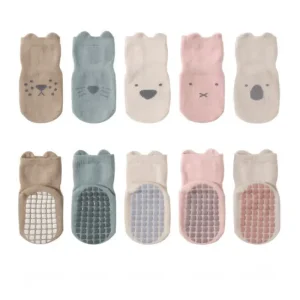
Non-Slip Cartoon Infant Socks with Ergonomic Grip Sole (OEM Mexico)
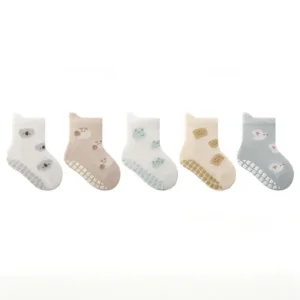
Breathable Summer Anti-Slip Baby & Toddler Socks (Volume Production)
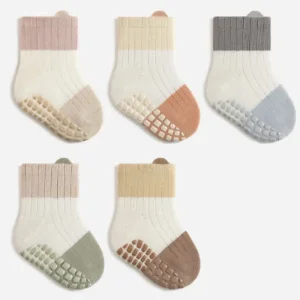
High-Traction Indoor Floor Baby Socks with Custom Color Ribbing
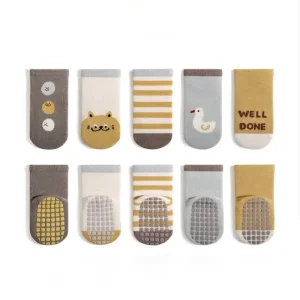
Mid-Tube Fall Weight Infant Grip Socks with Reinforced Heel & Toe
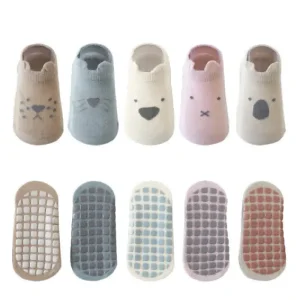
Custom Newborn Soft Cotton Crew Socks with Vulcanized Silicone Grips
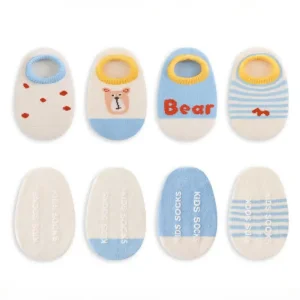
Low-Cut Comfort Ankle Baby Socks with Gentle Elastication (Mexico Stock)
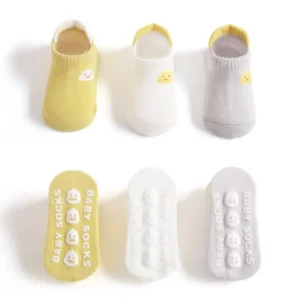
High-Volume Retail Non-Slip Toddler Ankle Socks for Department Stores
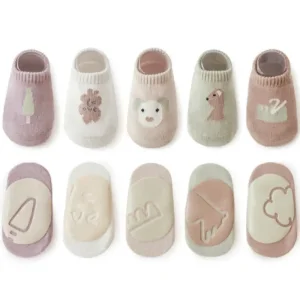
First-Step Walking Crew Socks with High-Coverage Traction Pattern