
Engineered Baby Socks Optimized for the French Market
Premium combed organic cotton constructions, seamless anti-pressure cuffs, and certified anti-slip micro-grips compliant with strict European infant safety standards.
The French Baby Hosiery Industrial Landscape & Sourcing Dynamics
A rigorous examination of production capacities in historical French knitting hubs, shifting retail margins, and the economic necessity of high-capacity overseas OEM alliances.
French Baby Sock Market
Annual retail volume across specialty retail, pharmacies & e-commerce
Import Dependency
Share of finished infant socks imported by French retailers due to local costs
DGCCRF Defect Limit
Stringent non-detection threshold for phthalates, azo dyes & loose threads
Global Organic CAGR
Projected compound growth rate for certified organic baby textiles through 2030
The Domestic Dilemma in France: Heritage vs. Economic Viability
France maintains an esteemed history in hosiery and knitwear manufacturing, centered historically in regions such as Troyes (Aube department), the Vosges, and Romilly-sur-Seine. Renowned heritage workshops uphold exquisite craftsmanship; however, the contemporary French infant apparel retail sector faces intense structural friction. The production cost of knitting a pair of multi-color infant socks domestically often exceeds €2.80 to €4.50 per unit at the factory gate, propelled by elevated energy overheads, specialized machine maintenance costs, and high labor charges.
Consequently, leading French kidswear labels, maternity brands, and retail groups (ranging from high-end boulevard boutiques in Paris to mass-market hypermarket networks across Lyon, Marseille, and Bordeaux) maintain design ateliers in France while relying on specialized, technologically sophisticated offshore OEM/ODM factories. To succeed in this market, foreign manufacturers must replicate European finishing standards, zero-defect linking, and stringent non-toxic chemical guarantees.
Strict Regulatory Compliance: DGCCRF, AGEC Law, and REACH
Importing baby socks into the French territory is subject to some of the world's most meticulous product safety and consumer protection frameworks. The French Directorate General for Competition Policy, Consumer Affairs and Fraud Control (DGCCRF) maintains ruthless vigilance over articles intended for infants under 36 months:
- OEKO-TEX® Standard 100 (Annex 6, Product Class I): Mandatory absence of carcinogenic arylamines, formaldehyde, chlorinated phenols, and extractable heavy metals down to baby saliva safety levels.
- Anti-Strangulation & Fiber Entanglement (EN 14878 / DGCCRF Protocols): Zero loose threads inside the toe area (toe loops must not exceed 2mm) to prevent tourniquet syndrome in infant digits.
- The French AGEC Law (Anti-Waste & Circular Economy): Mandates rigorous fiber traceability, eco-contributions (Refashion EPR scheme), and micro-plastic disclosure in consumer labeling.
Industrial Synergy: How Chinese Precision Manufacturing Powers French Brands
Modern Chinese hosiery production is no longer defined by commodity bulk output. Vertically integrated hubs, such as our advanced facilities, bridge the gap between French aesthetic elegance and scalable industrial competitiveness. By deploying 200-needle computerized Lonati and specialized circular knitting systems, proprietary eco-dyeing cycles, automated Italian Rosso and hand-linking machinery, and medical-grade liquid silicone injection lines, we produce infant socks that comfortably surpass European laboratory standards while delivering a 40% to 60% landed cost reduction for French procurement directors.
Standardized Technical Requirements for European Infant Hosiery
A technical reference blueprint for product developers, procurement officers, and quality assurance engineers supplying French retail channels.
| Component / Parameter | Technical Benchmark | Material Engineering Method | French / EU Regulatory Standard |
|---|---|---|---|
| Primary Fiber Composition | 75% - 82% Long-Staple Combed Cotton / Organic GOTS | Ring-spun 32s/2 or 40s/2 combed yarn with low pilling index | OEKO-TEX Standard 100 Class 1, GOTS Version 6.0 |
| Elastication & Core Matrix | 15% - 22% Spandex / Polyamide covered yarn | Double-covered air-jet elastane prevents direct skin contact with synthetic core | REACH Annex XVII (Zero PAH & restricted plasticizers) |
| Toe Seam Construction | Hand-linked "seamless" or Rosso 1-needle simulated hand finish | Zero ridge thickness, ultrasonic trim preventing loose internal loop threads (<1.5mm) | French DGCCRF Infant Finger Tourniquet Prevention Guidelines |
| Sole Anti-Slip Gripping | Eco-friendly food-grade liquid silicone rubber (LSR) | Automated screen printing or high-viscosity dot dispensing; peel adhesion > 35 N/cm | EN 71-3 (Migration of elements), LFGB & Phthalate-Free Directives |
| Cuff Compression Gradient | Pressure index between 4.0 - 6.5 mmHg | Non-binding roll-top ribbing or Lycra Soft Comfort band preventing ankle red marks | Pediatric Ergonomic Safety Standards for Micro-Circulation |
| Colorfastness Thresholds | Grade 4-5 to saliva, perspiration, and washing at 40°C | Reactive dyestuffs without aromatic amine liberation under reductive cleavage | ISO 105-E04 (Perspiration), ISO 105-E01 (Water), DIN 53160 (Saliva) |
Localized Applications & Commercial Use Cases in France
How global procurement teams structure SKU catalogs to address specific French institutional, clinical, and boutique lifestyle sectors.
French Maternity Wards & Cliniques (Maternités)
Every year, over 670,000 newborns enter the French hospital circuit. Public maternity units (Assistance Publique - Hôpitaux de Paris, Hospices Civils de Lyon) and private polyclinics provide welcome kits (Valises de Maternité). Our non-constricting, 100% hypoallergenic combed cotton socks with zero internal toe threads provide gentle warmth without restricting venous return in newborn micro-vessels.
Municipal Crèches & Halte-Garderies
French collective nurseries (crèches collectives and micro-crèches) implement strict indoor floor hygiene and fall-prevention rules. Toddlers transitioning from crawling to first steps require heavy-duty silicone grip socks that maintain traction on linoleum, treated hardwood, and non-slip rubber mats. Our food-grade silicone formulations withstand 60°C institutional laundering cycles without peeling or stiffening.
Premium Parisian Boutiques & Department Stores
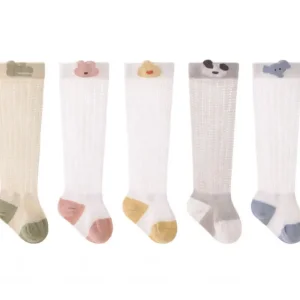
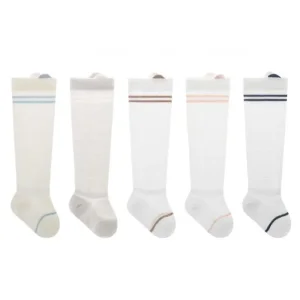
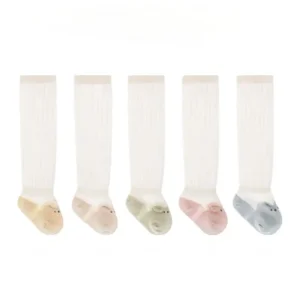
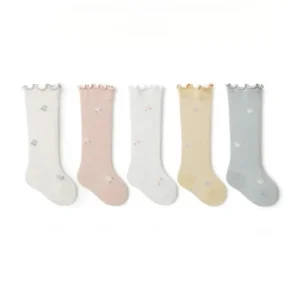
High-end retailers along Boulevard Haussmann, Saint-Germain-des-Prés, and Marais concept stores demand refined aesthetic subtlety: muted pastel tones, retro ribbed textures, pointelle lace openworks, and knee-high pompoms. We offer customized packaging including FSC-certified kraft paper bands, embroidered French tricolor accents, and bilingual French/English regulatory labels.
Indoor Soft-Play & Trampoline Parks
With family leisure hubs like Gulli Parc and Youpi Parc expanding across French commercial centers, custom branded grip socks serve as a high-margin mandatory safety requirement. We manufacture high-tensile anti-slip socks with full-sole custom silicone logo grips, offering color-coded sizing that simplifies queue management for venue staff.
Fast-Growing D2C Baby Sock Subscription Boxes
Direct-to-consumer e-commerce brands in France capitalize on subscription models supplying quarterly "growth-stage" sock packs. Our agile OEM minimum order quantities (from 500 to 1,200 pairs per colorway) allow rapid seasonal prototyping, multi-pack bundling, and drop-ship consolidation directly into EU fulfillment hubs.
Baby Shower & Baptism (Baptême) Gift Sets
French gifting culture places heavy emphasis on artisanal presentation for christenings, births, and family celebrations. We supply luxury rigid presentation boxes, embossed tinplate packaging, and ribbon-accented bootie-sock sets that achieve 65%+ gross margins at retail.
End-to-End Production Process for European Sourcing
From yarn testing to container drayage, our quality system adheres to strict AQL 1.0/2.5 protocols to eliminate batch variation.
Eco-Yarn Quality Verification
Incoming cotton and elastane cones undergo spectrographic color verification, tensile break checks, and certification audits for GOTS and OEKO-TEX Standard 100 compliance.
Computerized Circular Knitting
High-precision 144N, 168N, and 200N Lonati-type single and double cylinder machines knit dimensionally stable infant tubes with zero elastane tension irregularities.
Hand-Linking & Ultrasonic Inspection
Every pair undergoes manual toe linking or high-spec Rosso stitching, followed by 100% visual inspection on illuminated frames to confirm zero loose internal loops.
Liquid Silicone Application & Setting
Automated silkscreen printing cures medical-grade silicone patterns at 135°C, ensuring anti-slip grip resilience through 50+ household and institutional wash cycles.
Emerging Trends Reshaping European Baby Sock Procurement
Key technological, chemical, and design shifts observed by our R&D engineers across EU procurement networks.
1. Botanical & Biodegradable Fibers
French consumers increasingly favor plant-derived modal, bamboo viscose, and undyed organic virgin cotton. These fibers deliver natural hypoallergenic softness, bacteriostatic performance, and 30% higher moisture breathability than conventional ring-spun cotton.
2. Ergonomic "Barefoot" Gripping
Pediatric podiatrists in France recommend unrestricted natural foot development. Modern grip designs ditch rigid solid pads in favor of mapped silicone dots matching natural infant plantar pressure zones, ensuring optimal foot flex during early walking stages.
3. Zero-Plastic Retail Packaging
In accordance with France's single-use plastic ban, buyers demand plastic-free presentation. We supply 100% recycled paper hangtags, natural cotton twill tie loops, and biodegradable cornstarch (PLA) protective shipping sleeves.
B2B Procurement FAQs: Sourcing Baby Socks for France
Comprehensive answers addressing European compliance, Minimum Order Quantities (MOQ), laboratory testing, and international logistics.
Can you manufacture baby socks that fully comply with French DGCCRF infant safety regulations?
What are your typical Minimum Order Quantities (MOQs) for custom baby socks?
How do you verify the non-toxicity and adhesion durability of silicone grips on baby socks?
Do your production facilities hold international social compliance audits?
Can you assist with bilingual French labeling, barcodes, and EPR Refashion compliance?
What are the transit times and shipping options from your factory to Le Havre or Paris?
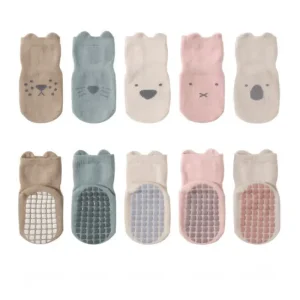
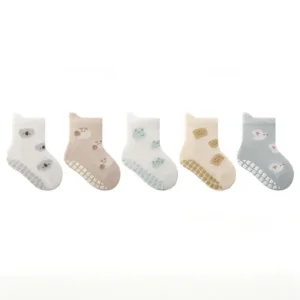
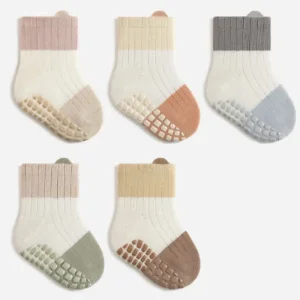
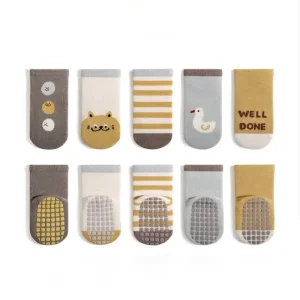
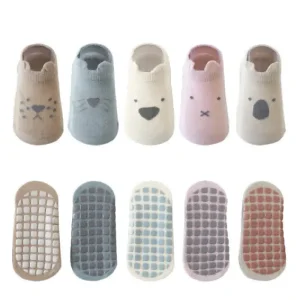
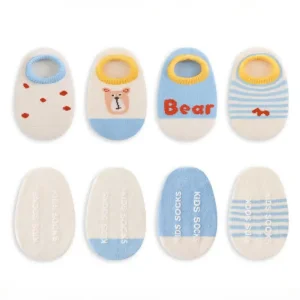
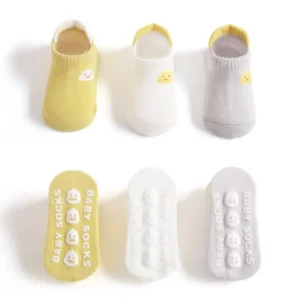
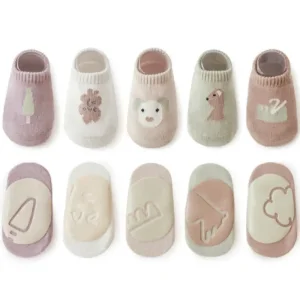
High-Volume Wholesale Baby & Toddler Socks for Global Distributors
Reliable, laboratory-tested models ready for private-label customization, packaging adaptation, and European market delivery.
Initiate Your Custom Baby Sock Sourcing Project
Partner directly with an audited, high-precision hosiery manufacturer. Request free physical pre-production sample sets, lab test certifications, and an expedited wholesale quotation for the French & European markets.
Send Inquiry Now