
High-Velocity Baby Socks for West African Climates
Engineered for high humidity, anti-vector protection, and hypoallergenic infant dermal safety across Ghana and broader ECOWAS consumer markets.
Commercial Realities of Baby Socks Manufacturing in Ghana
A data-backed evaluation of local textile manufacturing capacities, structural supply chain hurdles, and macroeconomic opportunities in Accra, Kumasi, and Tema.
The Demographic Imperative and Urban Retail Modernization
Ghana presents one of West Africa’s most stable and rapidly expanding consumer economies. With a median population age under 21 and sustained birth rates in metropolitan centers such as Greater Accra, Ashanti, and Western Regions, the consumption curve for maternal and infant apparel is experiencing double-digit year-over-year gains. However, when corporate procurement officers survey the landscape for "baby socks manufacturers & factories in Ghana," they encounter a pronounced structural dichotomy.
The domestic Ghanaian textile sector, traditionally anchored by celebrated heritage print manufacturers and decentralized cut-and-sew operations under industrial initiatives, lacks specialized high-precision circular hosiery knitting mills. Knitting infant socks requires automated ultra-fine-gauge cylinders (144N, 168N, and 200N), seamless hand-linking toe machines, and vulcanized liquid silicone printing carousels. Because localized infrastructure remains predominantly focused on woven fabrics and heavier garments, over 88% of Ghana's domestic baby sock consumption relies on cross-border supply networks.
Simultaneously, retail distribution channels within Ghana are undergoing rapid modernization. While open trading centers like Makola Market in Accra and Kejetia Market in Kumasi still absorb immense wholesale volumes, modern retail formats, baby boutique chains, and e-commerce platforms (such as Jumia and local social-commerce merchants) demand strict product consistency, barcode integration, hypoallergenic yarn certifications, and refined shelf-ready retail presentation.
Cost of Domestic Yarn Extrusion
Ghanaian knitting ventures face significant input costs due to localized shortages of combed compact organic cotton, synthetic elastic fibers, and Spandex covered yarns, forcing reliance on overseas raw filament imports.
Grid Reliability & Yield Consistency
Precision computerized knitting systems require zero power interruption. Fluctuations in industrial power grids introduce micro-defects in sock stretch tensions, making off-shore automated production vital for tier-one brands.
AfCFTA Gateway Potential
With the African Continental Free Trade Area (AfCFTA) Secretariat headquartered in Accra, institutional distributors are positioning Ghana as a duty-free warehousing hub to redistribute baby hosiery throughout West Africa.
Technical Roadmap & Climatic Product Engineering
Translating tropical equatorial conditions into precise textile specifications for neonates, infants, and walking toddlers.
Climatic Matrix: High Humidity, Elevated Ambient Heat & Vector Defense
Supplying baby socks to Ghana requires engineering that diverges substantially from temperate Western or European markets. The local ambient microclimate in coastal hubs like Accra and Takoradi exhibits relative humidity between 75% and 95% with temperatures routinely exceeding 30°C. Standard hosiery constructions with high synthetic polyester blends induce localized hyperhidrosis, cutaneous irritation, and heat rashes in young infants.
Our material roadmap addresses these physical demands through four interconnected technological pillars:
- Comb-Tensioned Organic Staple Yarns: Utilizing 32s/1 and 40s/1 long-staple combed cotton spun to minimize surface pilosity, ensuring optimal air circulation, moisture vapor transmission, and cutaneous breathability.
- Boneless Rosso & Hand-Linked Seamless Toes: Infant toes feature delicate dermal barriers vulnerable to friction bladders. Conventional ridge stitching is replaced with computer-controlled automatic linking, yielding a flat zero-friction interior line.
- Non-Invasive Hydro-Spandex Cuffs: Eliminating coarse natural rubber threads that leave deep constriction indentations on chubby infant calves, deploying double-wrapped low-denier Lycra to balance staying power without restricting micro-circulation.
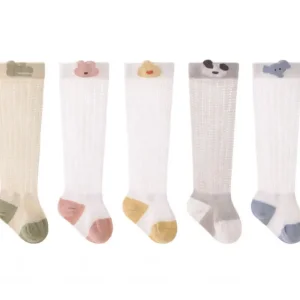
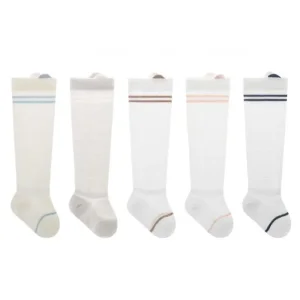
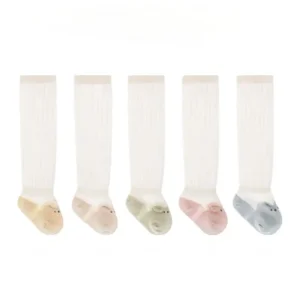
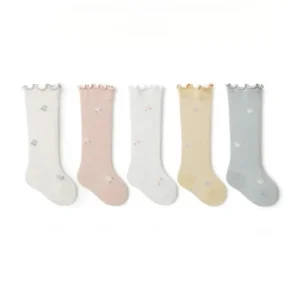
- Mosquito & Vector Shield Mesh Formats: Developing ultra-thin knee-high socks featuring microporous open-stitch eyelet matrices that protect neonates from insect bites during dusk hours without accumulating thermal heat.
Eco-Friendly Thermoregulation
Porous bamboo-cotton hybrid blends with high hygroscopic absorption capacity, dissipating perspiration rapidly across humid coastal sub-Saharan climates.
Zero-Heavy-Metal Dye Systems
Infants frequently ingest their foot coverings. Our reactive dye baths operate completely free of formaldehydes, AZO compounds, and heavy metal mordants, verified against OEKO-TEX Standard 100 Class 1.
Plastisol-Free Silicone Grippers
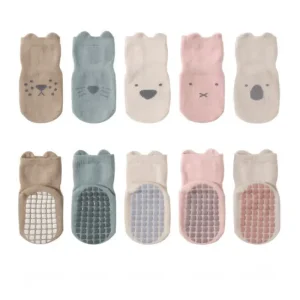
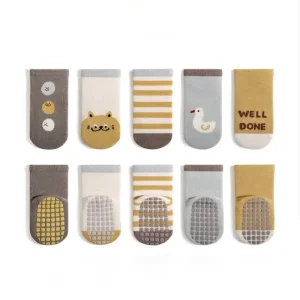
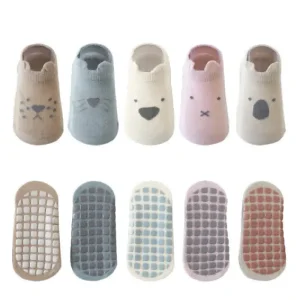
Non-slip floor crawling socks deploy medical-grade cured liquid silicone (LSR) dots, resisting tile shear forces on polished terrazzo and glazed ceramic floors common in Ghanaian households.
China Factory 4.0: Supply Chain Resilience & Efficiency
Bridging Chinese mega-scale manufacturing technology with Ghanaian and African commercial operations.
Vertically Integrated Ecosystem vs. Fragmented Assembly
For Ghanaian importers, multinational retail procurement leads, and international NGOs operating maternal aid supplies, procurement reliability depends entirely on supply chain integrity. Sichuan MiFo Technology Co., Ltd. demonstrates how centralized Industry 4.0 production resolves the cost and quality bottlenecks of regional manufacturing.
Spanning a unified 42,000 m² smart manufacturing park with an annual volume exceeding 200 million pairs, MiFo deploys automated Lonati circular knitting systems alongside in-line infrared yarn-break sensing, robotic sock-inverting machines, automatic linking tables, and computerized vacuum packaging units. This technological density allows buyers targeting the Ghanaian market to achieve unmatched price-to-specification ratios, fully counteracting domestic inflationary cycles.
Economies of Scale on Raw Materials
Direct bulk contracts for virgin combed cotton and specialty functional yarns isolate our partners from regional yarn spikes, keeping FOB and CIF unit margins predictably lean.
International Social Compliance
Our production facilities maintain continuous BSCI and Sedex pillar-4 audits, satisfying ethical compliance prerequisites for multinational hypermarkets, UN agencies, and global distributors.
99.4% Delivery Reliability Record
Leveraging redundant manufacturing lines across two corporate branches ensures that institutional high-volume container deliveries are shipped strictly within scheduled windows.
Macro Industry Solutions: Localization & Regulatory Compliance
Operational blueprints for seamless customs clearance through the Ghana Standards Authority (GSA) and the Port of Tema.
Navigating GSA Certification, ICUMS Declarations & Maritime Freight
Successful hosiery distribution into Ghana demands compliance with the Ghana Standards Authority (GSA) conformity assessment protocols, specifically the EasyPASS program (Pre-Export Verification of Conformity - PVoC). Consignments entering without certified laboratory inspection test reports face severe tariff fines, warehouse demurrages, or customs rejection.
MiFo provides an end-to-end localized regulatory support package:
- Pre-Export Verification of Conformity (PVoC): We coordinate directly with global inspection agencies (SGS, Intertek, Bureau Veritas) to furnish Certificates of Conformity (CoC) verifying fiber composition, color fastness, and non-toxicity prior to port loading.
- Integrated Customs Management System (ICUMS) Integration: Commercial invoices, packing declarations, and HS codes (typically under 6115.95 for cotton infant socks) are pre-formatted to match ICUMS taxonomy, eliminating terminal clearance delays at Tema or Takoradi ports.
- Tropical Moisture Barrier Packaging: Ocean freight through equatorial waters exposes cartons to high condensation humidity. We apply high-density poly inner liners, anti-mold desiccant sachets, and reinforced export master cartons tested for long-duration container transits.
- Private-Label Localized Branding: Dual currency and English/Twi retail header cards, anti-theft RFID tag application, and custom hanger polybagging ready for rapid retail display.
Ready to Scale Your Baby Socks Supply Chain in Ghana?
Connect with our senior technical hosiery engineers and global logistics consultants to configure your private-label baby sock collection with guaranteed international quality and competitive factory pricing.
Send Inquiry NowFull Spectrum Infant, Toddler & Anti-Slip Solutions
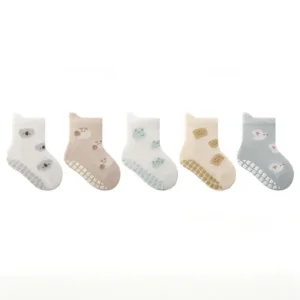
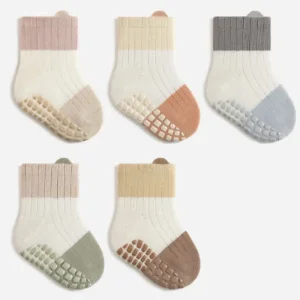
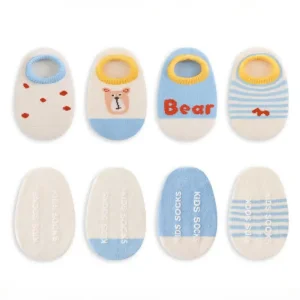
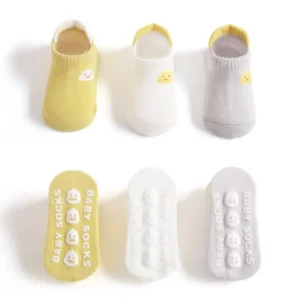
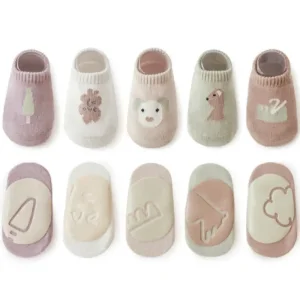
Engineered for high durability, anti-slip crawling grip stability, and versatile multi-climate infant use.
Ghana & Global Procurement: Frequently Asked Questions
Authoritative technical, commercial, and freight insights for retail category managers and supply chain directors.
While Ghana possesses strong traditional garment operations, high-speed computerized circular sock knitting requires automated 144N-200N needle cylinders, precision toe-linking robots, and certified chemical dye finishing facilities that are rarely available locally. Sourcing through MiFo provides certified OEKO-TEX Class 1 safety, exact sizing, anti-slip silicone applications, and production scale that keeps retail unit pricing affordable.
We coordinate with international testing bureaus (SGS/Intertek) to execute testing and obtain the Certificate of Conformity (CoC) mandated by the EasyPASS / PVoC framework. Every shipment includes certified documentation verifying zero formaldehyde, non-detectable AZO colorants, proper fiber ratios, and tensile grip bonding before dispatch to Tema.
Production sampling requires 3 to 7 days, followed by bulk knitting within 15 to 25 days depending on batch scale. Ocean maritime shipping from Shanghai/Ningbo or Shenzhen to Tema typically ranges between 28 and 38 transit days. For critical seasonal cycles, consolidated air cargo into Kotoka International Airport (ACC) delivers in 5 to 7 days.
Yes. We deliver turnkey OEM packaging, including customized hanger cards, multi-pair combo bundles, and retail counter display units. We can print local EAN-13 barcodes, GHS pricing, and care guidance in English or bilingual formats to ensure shelf-ready distribution across Ghanaian supermarket and retail chains.
Our standard MOQ starts at 500 to 1,000 pairs per design/colorway depending on yarn complexity and Jacquard detailing. For larger institutional programs or regional wholesale hubs, volume scaling unlocks aggressive cost-downs to maximize retail margin competitiveness.
Every master carton is lined with a sealed waterproof polyethylene barrier. We integrate industrial non-toxic desiccant packs inside both inner unit boxes and outer heavy-duty corrugated export cartons, preventing moisture condensation during transit across tropical sea corridors.