Precision Infant Knitwear for the Australian Market
Engineered for high breathability, thermal comfort, and rigorous safety standards across Oceania.
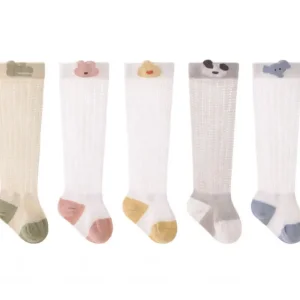
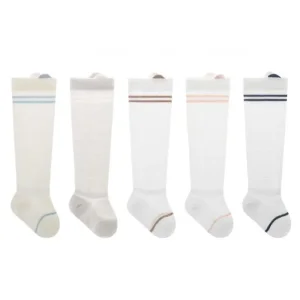
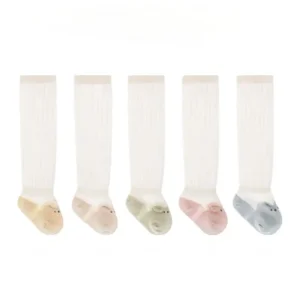
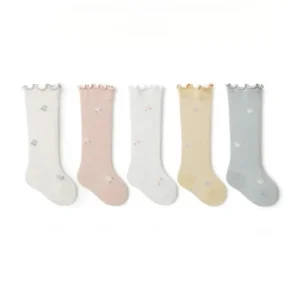
The Australian Baby Socks Commercial & Industrial Reality
Australia represents one of the highest per-capita spending markets for infant apparel and hosiery in the Asia-Pacific region. With approximately 300,000 newborns annually and an affluent consumer base prioritizing natural, hypoallergenic fibers, the retail sector—encompassing major department stores (such as Kmart, Target Australia, Big W), national pharmacy banners (Chemist Warehouse, TerryWhite Chemmart), and high-growth boutique D2C brands—faces distinct supply chain complexities.
Domestic textile manufacturing within Australia operates under acute structural pressures. High award wage mandates (averaging over $30–$35 AUD per hour for skilled textile machinists), steep energy tariffs across New South Wales and Victoria, and limited upstream spinning infrastructure have caused local Australian hosiery mills to contract significantly over the last three decades. The remaining domestic facilities primarily focus on specialized industrial workwear, medical compression, or micro-batch wool knitting.
Consequently, Australian brands seeking scalable, compliant, and commercially viable infant socks must establish integrated partnerships with overseas advanced manufacturing bases capable of meeting stringent Australian Consumer Law and specialized pediatric physical testing protocols.
Australian Procurement Economic Metrics
Macro Dynamics Shaping the Baby Socks Sector
Strategic purchasing behavior in Australia reflects broader international shifts toward non-toxic material safety, early development biomechanics, and climate-adaptive textiles.
Zero-Yarn-Loop & Toe-Ligature Prevention
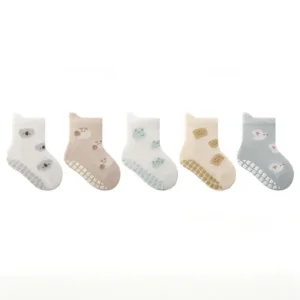
Pediatric safety bodies in Australasia highlight the critical hazard of hair-thread tourniquet syndrome, where unclipped float threads inside machine-knitted infant socks wrap around toes. Global procurement directors now mandate seamless computer-linked toe finishes (Rosso closure or true hand-linking) alongside inverted jacquard or digital printing that eliminates internal floating threads completely.
- Zero loose interior floats
- True flat-seam or hand-linked closure
- ACCC physical safety adherence
Phthalate-Free Grip Geometries for Flooring
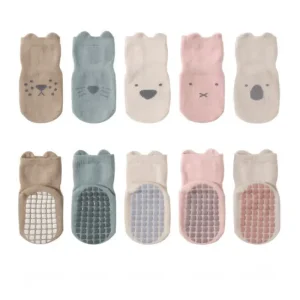
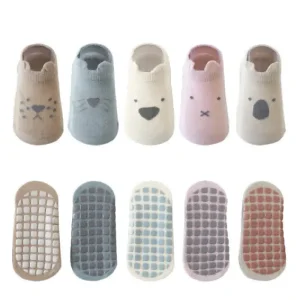
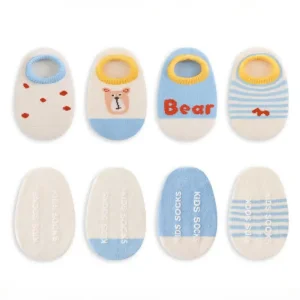
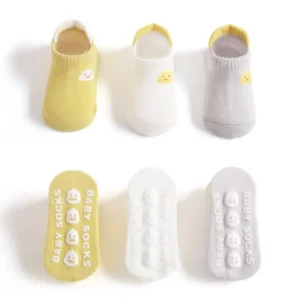
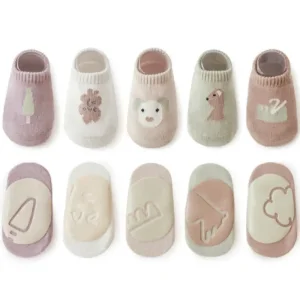
The predominance of timber floorboards, polished concrete, and ceramic tiling in modern Australian residential architecture has elevated non-slip grip socks from an optional feature to an absolute consumer prerequisite. Australian retailers require proprietary silicone grip compounds that maintain anti-slip traction across repeated commercial laundering cycles without peeling or leaching endocrine disruptors.
- Medical-grade non-migrating silicone
- EN 71-3 / REACH phthalate compliance
- Custom 3D molded branded grip dots
Climate-Adaptive & Sun-Safe Knee-High Knits
Australia’s intense UV radiation index and distinctive sub-tropical climates (spanning Queensland, Northern Territory, and Western Australia) have created a surging commercial niche for ultra-thin, breathable, knee-high insect-barrier socks. In contrast, southern markets demand fine-gauge combed cotton blended with soft Australian merino wool for winter thermoregulation without dermal irritation.
- Mesh ventilation zones over instep
- Organic long-staple combed cotton
- UPF-rated knit structures for active toddlers
Industry 4.0 Factory Architecture
Deploying fully synchronized Italian and Japanese computerized knitting machinery on a single, socially verified campus:
China Factory 4.0: Supply Chain Resilience & Precision Engineering
For Australian brands, the choice of a manufacturing partner is not simply a low-cost transaction; it is a hedge against inventory volatility, tariff friction, and product liability. Modern Chinese industrial ecosystems have evolved far beyond manual assembly. Our Sichuan-based mega-manufacturing site exemplifies Hosiery Industry 4.0, integrating digital yarn tensioning, algorithmic pattern mapping, automated toe closure, and centralized logistics under one audited roof.
With an annual output exceeding 200 million pairs, our infrastructure provides oceanic brand partners with unmatched elasticity. Whether executing a seasonal retail pipeline for nationwide distribution across Australia or rapid-turn restocking for top-ranking Amazon Australia / Shopify D2C collections, computerized scheduling reduces yarn changeover downtime from hours to minutes.
Furthermore, vertical integration eliminates middleman price distortion. Raw combed organic cotton, dyed modal yarns, spandex core-spun threads, and silicone compounding are managed through unified ERP systems, ensuring exact batch-to-batch color match tolerances within Delta E < 0.8.
Commercial Application Scenarios Across Australia
How customized infant hosiery specifications serve diverse commercial channels and institutional use cases throughout Oceania.
Tier-1 Department & Supermarket Chains
Wholesale distribution through major Australian retailers requires multi-pack hanger merchandising, strict GS1 barcode accuracy, and standardized shelf hanging tags. Our lines engineer multi-pack bundles (3-pair, 5-pair, 7-day sets) packaged in FSC-certified paperboard, designed to withstand high-volume retail handling while meeting competitive target retail price tiers ($8.00–$14.00 AUD retail SRP).
- High-speed automated packaging packaging
- Custom header cards with plastic-free hooks
- EDI and carton-level pallet labelling
Boutique Organic & Lifestyle D2C Brands
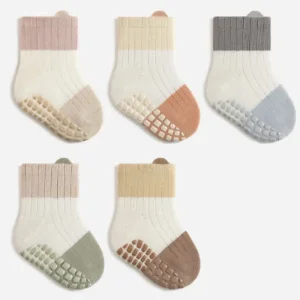
High-end Australian children's fashion brands—centered in hubs like Byron Bay, Melbourne, and Sydney—demand refined aesthetics: earthy muted palettes (eucalyptus green, desert ochre, dusty rose), rib-knit textures, scalloped picot cuffs, and GOTS-certified organic cotton. We provide custom low-MOQ sample runs and Pantone color dyeing to match seasonal lookbooks precisely.
- Eco-friendly reactive dyestuffs (azo-free)
- Vintage 2x2 and 3x1 ribbed textures
- Biodegradable cornstarch packaging pouches
Early Childhood Education & Indoor Play Venues
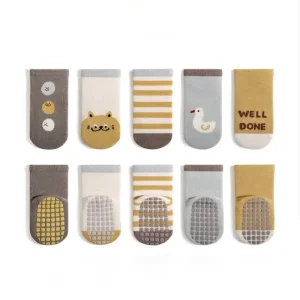
Under the National Quality Framework (NQF) governing Australian Early Childhood Education and Care (ECEC) facilities, slip-and-fall mitigation is an occupational and child-safety focus. Daycare centers, play gyms, and indoor recreation franchises order bulk customized anti-slip socks featuring high-density grip footprints and size-coded color palettes for easy sorting by educators.
- Heavy-duty silicone traction prints
- Color-coded heel collars by developmental age
- Resistant to high-heat commercial autoclaving
Australian Local Production vs. Industry 4.0 Contract Sourcing
A rigorous engineering and financial comparison designed for chief procurement officers and inventory merchandisers.
| Evaluation Parameter | Australian Domestic Hosiery Facilities | Advanced Industry 4.0 China Partner | Strategic Impact for Australian Brands |
|---|---|---|---|
| Cylinder Needle Capabilities | Primarily 96N–120N coarse gauge | 108N, 120N, 144N, 168N, 200N ultra-fine | Enables ultra-soft, zero-ligature density for newborn skin |
| Toe Seam Finishing Tech | Traditional machine Rosso linked seam | Automated zero-feel hand-linked imitation | Eliminates sensory irritation and toe pressure marks |
| Silicone Anti-Slip Integration | Outsourced or manual batch heat-press | Rotary high-speed automated screen curing | Guarantees 50+ wash cycles without rubber delamination |
| Direct FOB Unit Cost (AUD) | $3.80 – $6.20+ (Ex-Factory) | $0.55 – $1.45 (Landed Duty Paid basis) | Increases gross margin spread from 38% to 68%+ |
| Custom Dye Matching & Lab Dips | Limited stock yarn colors only | Pantone TCX matching in 48–72 hours | Enables distinctive seasonal collection storytelling |
| Packaging Compliance | Manual packing; limited automation | Automated carton packing, FSC hangtags, UPC codes | Direct cross-docking readiness into Australian 3PL hubs |
Answers to Critical Procurement Questions
Addressing compliance, customs tariffs, safety testing, and freight logistics for Oceanic buyers.
What specific mandatory safety standards apply to baby socks imported into Australia?
How does the China-Australia Free Trade Agreement (ChAFTA) impact customs tariffs on socks?
What needle count is optimal for infant vs. toddler socks for Australian retail?
Can our brand customize the exact formulation and pattern of the silicone bottom grip?
What is the typical shipping transit time from factory to major Australian ports?
What is the minimum order quantity (MOQ) for custom private-label collections?
High-Performance Infant & Toddler Grip Solutions
Engineered with non-constrictive welts, anti-slip traction soles, and certified baby-safe materials.