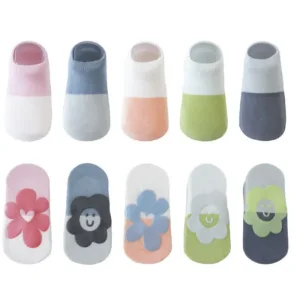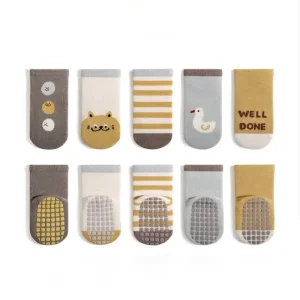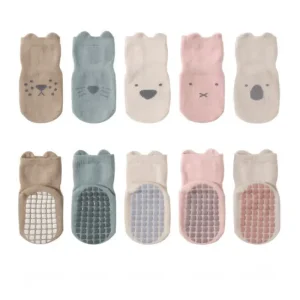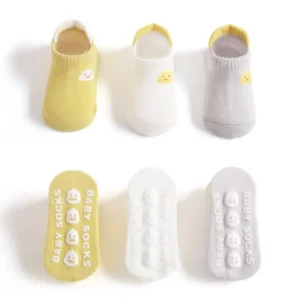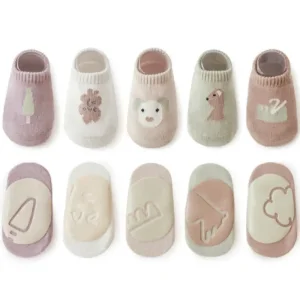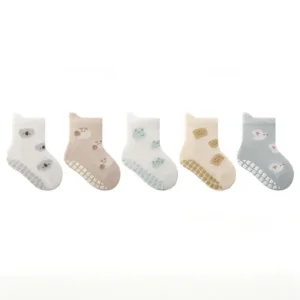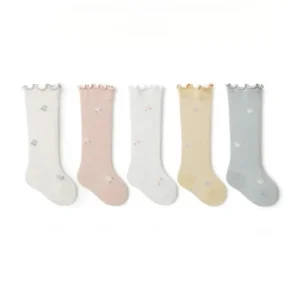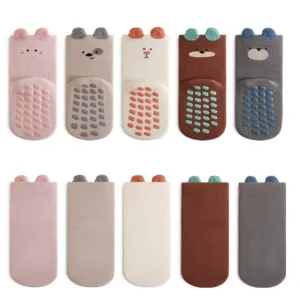
Featured Newborn & Infant Technical Sock Collection
Engineered specifically for neonate and toddler biomechanics. Manufactured using ultra-fine gauge automated knitting, hand-linked seamless toes, and medical-grade non-slip sole vulcanization.
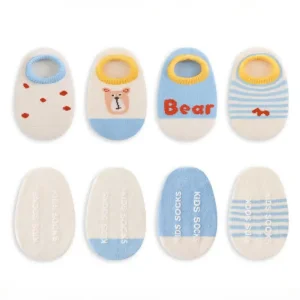
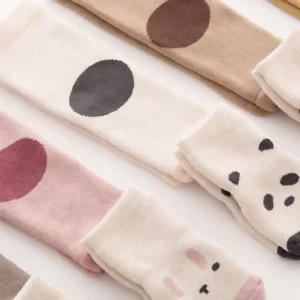
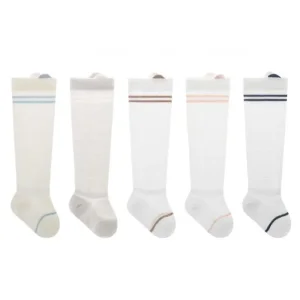
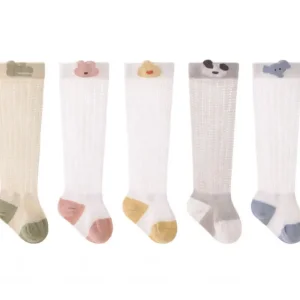
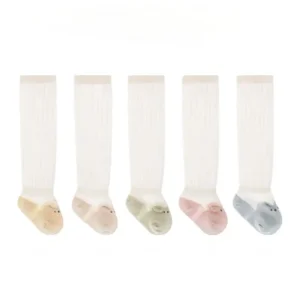
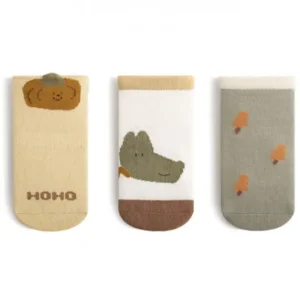
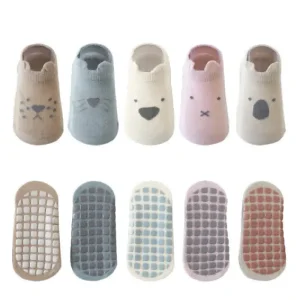
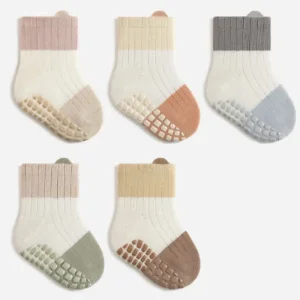
Macro Industry Solutions: Pediatric Textile Architecture & Dermatological Safety
Infant and neonate hosiery manufacturing demands an entirely different paradigm from adult apparel. Newborn epidermis is up to 30% thinner than mature adult skin, featuring underdeveloped stratum corneum barriers, hypersensitive tactile nerve endings, and higher moisture vapor loss rates.
Yarn Matrix & Fiber Physics
We source exclusively long-staple combed cotton (staple lengths ≥ 33mm) ring-spun into high-gauge counts (32s/1, 40s/1, and compact siro-spun 50s/2). By removing loose microscopic fibrils prior to knitting, yarn shedding is eliminated, drastically curtailing neonatal ingestion risks and lint accumulation between developing toes.
Zero-Constriction Cuffs
Traditional elastic bands risk inducing infant circulatory tourniquets. Our computerized cylinders engineer differential tension ribbing utilizing core-spun micro-denier spandex (20D/30D encapsulated in combed organic fibers). This delivers secure retention across delicate ankles without exerting pressure beyond a gentle 4-6 mmHg threshold.
Seamless Toe Linkage
Bulky Rosso seams cause persistent frictional micro-abrasions along vulnerable neonate metatarsals. We mandate automated optical hand-linking (Kettenstich linking), which aligns needle stitches point-to-point to yield an absolute 180° flat, imperceptible seam line that prevents skin lesions and toe-ring constriction.
Engineering Note: The Prevention of Hair Tourniquet Syndrome & Yarn Entrapment
In contract newborn sock manufacturing, unchecked float threads on the sock interior present a severe medical hazard known as hair-thread tourniquet syndrome. Our manufacturing protocols utilize specialized computerized single-cylinder intarsia and floating-thread trimmer mechanisms that limit reverse floats to ≤ 1.5mm, complemented by 100% manual inverse-turning inspections prior to autoclave steam stabilization.
Global Commercial Landscape & Supply Chain Geopolitics
The global infant hosiery market has evolved from low-cost generic consumables into high-specification functional apparel driven by premium direct-to-consumer (DTC) brands, maternity health networks, and regulated hypermarket retailers.
North American Standards
Dominated by aggressive ASTM F963 small parts scrutiny and stringent CPSIA enforcement. Demand is heavily concentrated on high-density anti-slip grip footies, organic unisex earth-tone palettes, and multipack bundle logistics tailored for Amazon FBA and big-box distribution.
European Union Mandates
Prioritizes zero chemical migration under EU REACH Annex XVII, strict formaldehyde caps (< 16 ppm), and complete Oeko-Tex Standard 100 Class I verification. German and Nordic buyers demand GOTS-certified organic cotton and FSC-certified recyclable kraft packaging.
APAC Growth Corridors
Rapidly expanding demand in Japan, South Korea, and Tier-1 Chinese metropolises for ultra-breathable mesh ankle socks, modal blends, and open-weave mosquito-repellent knee-highs that accommodate intense summer humidity and indoor barefoot floor cultures.
Emerging Middle East Sector
High preference for luxury gift sets, delicate lace and ruffle embellishments, and ultra-soft mercerized cotton blends engineered to maintain structural integrity across constant laundering in automated high-temperature washers.
| Cylinder Needle Count | Target Age Cohort | Fiber Composition | Machine Gauge & Diameter | Primary Industrial Application |
|---|---|---|---|---|
| 84N - 96N (Single Cylinder) | Preemie to 0-3 Months | 82% Combed Cotton, 15% Nylon, 3% Spandex | 3.00" / 3.25" Super-Fine Gauge | Maternity clinics, NICU thermoregulation booties, newborn hospital packs |
| 108N - 120N (Computerized) | 3-12 Months (Infant) | 78% Organic Cotton, 19% Polyester, 3% Elastane | 3.25" / 3.50" Compact Mesh/Terry | First-steps anti-slip floor socks, daywear crew socks, crawling knee warmers |
| 132N - 144N (High Precision) | 12-24 Months (Toddler) | 75% Bamboo Viscose, 22% Nylon, 3% Spandex | 3.50" / 3.75" Ultra-Dense Knit | Commercial play centers, daycare grip socks, seasonal anti-mosquito tubes |
| 168N (Micro-Jacquard) | 0-24 Months (Boutique) | 85% Long-Staple Cotton, 12% Polyamide, 3% Lycra | 3.75" High-Resolution Cylinder | Luxury retail department stores, intricate branded logos, lace picot edge socks |
Localized Compliance, Chemical Safety & Factory Traceability
Supplying regulated retail chains such as Target, Walmart, Carrefour, and Mothercare requires an unyielding audit trail. Our Sichuan manufacturing facility operates under comprehensive international social and chemical certifications.
OEKO-TEX Standard 100 (Class I)
Class I represents the most rigorous textile testing tier globally, specifically reserved for infants up to 36 months. We guarantee absolute non-detectable readings for carcinogenic arylamines, free formaldehyde (<16 mg/kg threshold), phthalates, pentachlorophenol (PCP), and allergenic dispersion dyes.
CPSIA & ASTM F963 Compliance
For the United States market, every production run meets 16 CFR Part 1500 and 1501 regulations. Adhesives and cured silicone grip dots undergo mechanical pull tests exceeding 15 lbf (66.7 N) tension for 10 seconds to verify that grips, decorative bows, or rattles never detach and present a choking risk.
BSCI & Sedex SMETA 4-Pillar
Modern consumers and corporate buyers demand ethical supply transparency. Our manufacturing complex undergoes regular unannounced Sedex and BSCI social audits, certifying zero child labor, fair wage frameworks, occupational workplace safety, and circular wastewater treatment management.
B2B Application Scenarios & Custom Commercial Formats
Infant socks serve multifaceted functions across medical, domestic, and recreational spaces. We architect purpose-built configurations aligned with exact operational environments.
Hospital & NICU Neonatal Packs
Medical-grade thermal stabilization booties engineered without internal seams or loose threads. Knitted with unbleached organic virgin cotton to avoid optical brighteners, sterilized using gamma radiation or autoclave-ready steam bags, ensuring hyper-pure sterility for premature infants in maternity wards.
Early Crawling & First-Steps Footwear
During the crucial 6-18 month motor-skill window, toddlers require tactile floor feedback without losing frictional traction. We engineer ergonomically mapped silicone or PVC grip arrays matching the arch, heel, and forefoot strike points, supporting natural posture without hindering gait progression.
Multi-Climate & Outdoor Protective Tubes
Engineered for high seasonal variability. In summer, fine-gauge jacquard mesh knee-high socks incorporate natural citronella micro-capsules to deter mosquitoes while facilitating continuous heat dissipation. In winter, dense loop-terry lining locks in core body warmth on cold hardwood and tile surfaces.
Technological Roadmap: AI Automation & Sustainable Manufacturing
Our ongoing R&D investments bridge advanced robotic manufacturing, machine-vision defect detection, and closed-loop bio-polymer textile engineering.
Vision AI In-Line Quality Inspection
By outfitting high-speed knitting cylinders with multi-spectrum high-resolution CCD cameras, our proprietary AI model detects dropped stitches, uneven tension lines, and broken filaments in real-time at 320 RPM, immediately pausing defective cylinders and slashing scrap rates below 0.3%.
Solvent-Free Liquid Silicone Molding (LSR)
Replacing traditional solvent-borne plastisol PVC screen printing, our eco-friendly automated liquid silicone rubber (LSR) molding system ensures zero volatile organic compounds (VOCs). The resulting grips offer superior thermal endurance, withstanding over 50 commercial boil washes without delaminating.
Bio-Circular Yarn Formulations
Pioneering the adoption of polylactic acid (PLA) fibers derived from non-GMO plant starches, blended with regeneratively farmed organic cotton. This engineering breakthrough ensures that worn-out socks degrade naturally under industrial composting conditions without leaving microplastic residues.
Frequently Asked Questions for Commercial Buyers
Detailed technical and commercial answers directly from our engineering team to assist global purchasing managers, supply chain directors, and retail brand founders.
For custom designs requiring bespoke jacquard artwork, custom PMS yarn dyeing, and specialized silicone grip patterns, our standard MOQ is 1,200 pairs per style/colorway across 2-3 size breakdowns. For catalog replenishment with existing stock yarns, we can accommodate trial runs starting at 500 pairs per batch.
We employ a high-temperature cure vulcanization process where liquid silicone penetrates the outer cotton loops at 165°C under pneumatic pressure. Finished goods undergo rigorous mechanical pull testing exceeding 15 lbf (66.7 N) tension for 10 continuous seconds, alongside 20 wash-cycle stress tests in accordance with ASTM F963-17 small parts safety mandates.
Every export container is accompanied by comprehensive third-party lab documentation (SGS, Intertek, or TÜV Rheinland), including Oeko-Tex Standard 100 Class I certificates, CPSIA Children’s Product Certificates (CPC), Lead and Phthalate test reports, Azo dye exclusion records, and fiber composition verification documents.
Physical sampling and CAD counter-proofing take 5-7 business days. Upon sample approval and deposit confirmation, bulk production of 50,000 to 200,000 pairs completes within 25-30 calendar days. Expedited air shipping, sea freight (FOB Shanghai/Shenzhen or CIF destination), and DDP rail to European hubs are handled seamlessly by our export logistics team.
A sock made of 100% pure raw cotton lacks elasticity and will immediately slouch and slide off a baby’s active foot. The industry gold standard for '100% cotton socks' utilizes 100% organic cotton on the surface yarns that directly contact skin, plated over a core of fine spandex and nylon filament (typically 78-82% cotton, 15-18% nylon, 2-3% spandex) to provide essential mechanical elasticity and recovery.
We supply fully customized, retail-ready packaging formats including FSC-certified recycled cardstock header cards, embossed slide-out gift boxes with magnetic closures, cotton drawstring pouches, and biodegradable cornstarch-based polybags. Barcode printing, UPC tagging, and retailer EDI compliance labeling are fully integrated into our final packing line.
Specialized Wholesale Infant & Toddler Footwear Showcase
Explore our extended industrial range covering four-season novelty ankle socks, mid-tube grip floor socks, high-performance breathable knee socks, and certified organic combed cotton models.