
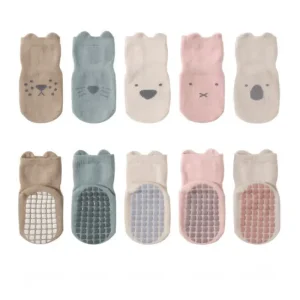
Featured Cleanroom & Performance Grip Solutions
Precision-knitted formulations engineered with particulate barrier containment, silicone micro-dots, and high-recovery technical yarns.
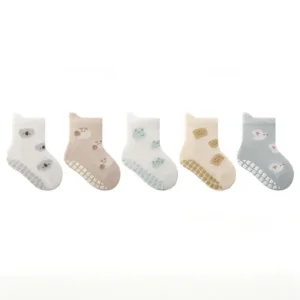
Wholesale Anti Slip Kids Socks for Newborn Baby Toddler Infant in Summer
Product Specifications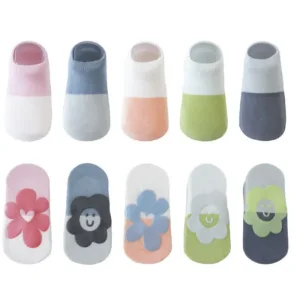
Custom Cotton Cute Anti Slip Baby Ankle Socks with Cartoon Spring Autumn
Product Specifications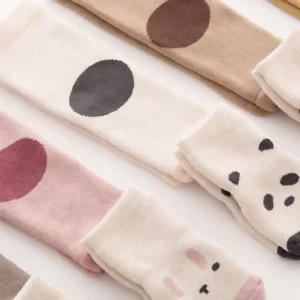
Custom Wholesale High Quality Baby Socks Over Knee High Toddler Socks
Product Specifications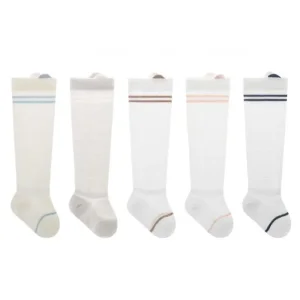
Wholesale Thin Baby Socks with Cute Cotton Knee High Mosquito Proof
Product Specifications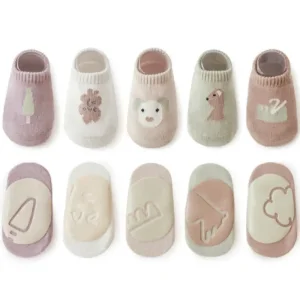
High-Quality Non Slip Toddler Socks Cute Cartoon Baby Socks With Grips
Product Specifications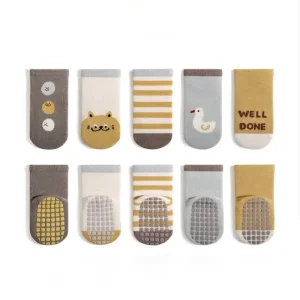
Wholesale Factory Price Floor Grip Mid-tube Socks Character Kids
Product Specifications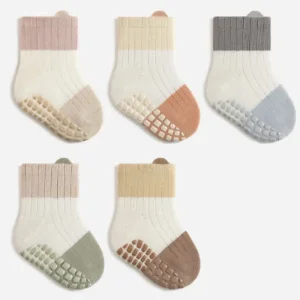
Custom Wholesale Colorful Kids Socks Indoor Floor Anti Slip Socks
Product SpecificationsIndustrial Whitepaper: Critical Cleanroom Microclimate Dynamics
Beyond standard hosiery: How continuous filament polymers and ESD conductive matrices mitigate electrostatic breakdown and particulate contamination.
Particle Shedding & Helmke Drum Criteria
In Class 100 to Class 10,000 cleanrooms, human operators account for up to 80% of microparticulate contamination. Conventional cotton socks shed short-staple cellulosic fragments that bypass secondary boot barriers. Our specialized cleanroom socks utilize continuous filament textured polyester (CF-PET) or micro-denier polyamide, certified under IEST-RP-CC003.4 to retain Category 1 lowest particle shedding performance.
ESD & Dissipative Conductive Pathways
Static discharge (ESD) presents catastrophic yields risks in sub-nm wafer fabs and SMT assembly lines. By co-knitting high-density carbon-suffused nylon filament or pure silver-plated threads throughout the footbed, our cleanroom socks maintain a verified point-to-ground resistance of 10^6 to 10^8 Ohms in compliance with ANSI/ESD STM 97.1 and IEC 61340-5-1 standards.
Thermo-Physiological Ergonomics
Cleanroom operatives undergo prolonged 12-hour rotational shifts inside non-breathable Tyvek or conductive coveralls. We implement seamless toe-closing link technology paired with moisture-transport micro-groove capillary cross-sections. This prevents maceration, bacterial growth, and uncomfortable pressure points across the metatarsal and calcaneus zones.
Global Industrial Applications & Localization
Tailoring engineered footwear to cleanroom microenvironments across North America, Europe, East Asia, and the Global South.
Semiconductors & Microelectronics
Key Hubs: Taiwan, South Korea, Dresden (Silicon Saxony), Phoenix/Austin (USA).
Requirement: Stringent static control to eliminate sub-surface gate oxide damage during 3nm/2nm lithography handling. Footwear must balance triboelectric charging below 20V with absolute zero sloughing of volatile organic compounds (VOCs).
Biopharmaceuticals & Sterile Compounding
Key Hubs: Basel (Switzerland), New Jersey/Boston (USA), Ireland, Singapore.
Requirement: Grade A/B isolator cleanrooms mandating EU GMP Annex 1 compliance. Socks must withstand recurring gamma irradiation (25-45 kGy) or ethylene oxide (EtO) sterilization cycles without polymer embrittlement or yellowing.
Aerospace, EV Optics & Medical Devices
Key Hubs: Germany, Japan, California, Yangtze River Delta.
Requirement: Critical sensor assembly and satellite optics require Class 1,000 cleanroom compliance with zero silicone migration. Footwear silicone grips must be certified non-outgassing to prevent lens haze.
China Supply Chain Resilience & Manufacturing Agility
Vertical integration from raw polymer extrusions to Class 100 clean packaging gives MiFo clients unmatched scale and velocity.
42,000 m²
Modern Manufacturing Footprint
200M+
Annual Unit Output Capacity
99.4%
On-Time Global Delivery Rate
100+
Export Destination Markets
End-to-End Vertical Control
By unifying spinning, circular knitting, automated robotic linked toes, silicone dispensing, clean laundering, and vacuum packaging inside our Sichuan complex, we eliminate third-party subcontractor delays and cross-contamination risks entirely.
Rapid Prototyping & Tooling
With over 600 advanced high-gauge computerized knitting heads (168N, 200N, and ultrafine 240N), custom technical specifications, compression gradients, and conductive grid topologies can be sampled and laboratory-tested within 48 to 72 hours.
Buffer Stock & Blanket Contracts
To shelter global supply chain directors from geopolitical and shipping fluctuations, we offer dedicated safety stock programs, JIT (Just-In-Time) warehousing, and customs-bonded transit solutions to major hubs worldwide.
Engineering Matrix: Cleanroom Specification Guide
Benchmarking cleanroom class classifications, fiber blends, and functional performance benchmarks.
| Cleanroom Grade | Primary Fiber Composition | ESD Surface Resistivity | Particle Cleanliness Class | Recommended Sterilization |
|---|---|---|---|---|
| ISO 4 / Class 10 | 100% Continuous Filament Polyester + 2% Belltron® Carbon | 1.0 × 10^5 to 1.0 × 10^7 Ω | IEST Category 1 | Gamma Irradiation (35 kGy) / Autoclave |
| ISO 5 / Class 100 | 98% Micro-denier Polyester + 2% Conductive Carbon Grid | 1.0 × 10^6 to 1.0 × 10^8 Ω | IEST Category 1 | EtO Sterilization / Clean Laundering |
| ISO 6-7 / Class 1K-10K | 85% Low-Lint Synthetic Blend + 12% Spandex + 3% Static Line | 1.0 × 10^7 to 1.0 × 10^9 Ω | IEST Category 2 | Industrial Cleanroom Laundering |
| ISO 8 / General Clean | Long-Staple Combed Cotton Core with Synthetic Outer Shell | Dissipative Natural Moisture (10^9 - 10^10 Ω) | Standard Industrial | Standard High-Temp Thermal Disinfection |
Ethical Audit Standards & Quality Compliance
Operating under full transparency, third-party social accountability, and uncompromising safety validation.
BSCI & Sedex Audited
Sichuan MiFo Technology facilities undergo annual SMETA 4-Pillar and BSCI audits to assure fair living wages, chemical safety handling, non-discrimination, and ethical occupational hygiene. Audit summaries and certificates are available on demand.
OEKO-TEX® Standard 100
All yarn lots, dyeing chemicals, elasticizers, and silicone adhesives are tested and verified free from harmful substances, heavy metals, formaldehyde, and phthalates, fulfilling REACH Annex XVII and California Proposition 65 requirements.
Lot Traceability & CoAs
Every production batch is accompanied by Certificate of Analysis (CoA) documentation detailing surface resistance, lint shedding parameters, burst strength, and dimensional stability before dispatch, providing flawless QA transparency.
Expanded OEM/ODM Product Production Lines
Versatile manufacturing spans infant anti-slip wear, hospital safe-step hosiery, active grip socks, and custom institutional volume lines.
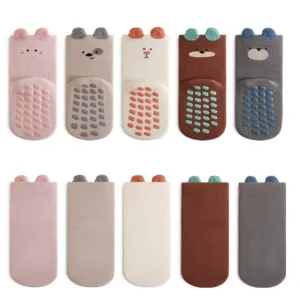
Wholesale Custom Anti Slip Soft Kids Socks Breathable Comfortable Grip
Product Specifications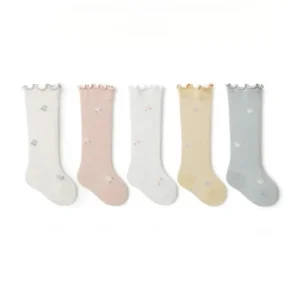
High-Quality 100 Percent Cotton Socks Eco-Friendly Organic Knee High
Product Specifications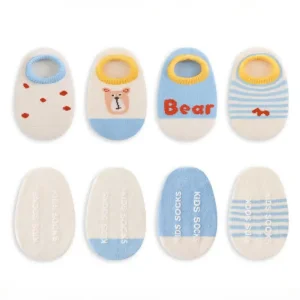
Wholesale Factory Colorful Soft Baby Socks Anti-slip Cotton Ankle
Product Specifications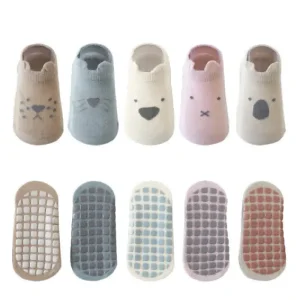
Custom Newborn Soft Anti Slip Infant Socks Cotton Crew With Silicone Grips
Product Specifications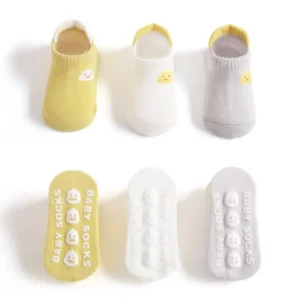
Wholesale Hot Sale Kids Socks Wholesale Non Slip Soft Ankle Baby Toddlers
Product Specifications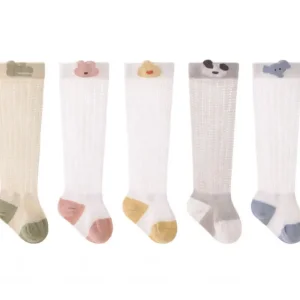
Wholesale Custom Baby Socks Long Tube Breathable Seamless Spring Summer
Product Specifications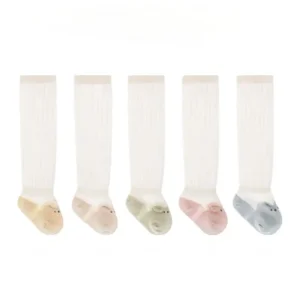
High-Quality Cooling Cartoon Infant Socks Knee-High Colorful Baby Socks
Product Specifications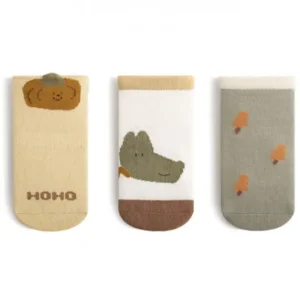
Custom Wholesale Breathable Baby Socks Grip Cartoon Toddler Anti-Slip Cotton
Product SpecificationsTechnology Roadmap: Next-Gen Cleanroom Hosiery
Investing in sustainable biopolymers, bio-monitoring sensors, and advanced antimicrobial nanocoatings.
Phase 1: Graphene Nanoplatelet Integration
Embedding multi-layer graphene inside polyester core masterbatches to create uniform electrical conductivity without carbon flaking, achieving permanent static dissipation that endures 100+ industrial autoclave cycles.
Phase 2: Closed-Loop Recycled Clean Fibers
Transitioning industrial cleanrooms to circular economies via mechanically and chemically depolymerized rPET continuous filaments, delivering equivalent particulate containment while decreasing product carbon footprints by 48%.
Phase 3: Sensor-Enabled Smart Footwear
Developing knitted piezoresistive arrays capable of monitoring worker fatigue, posture, and gait kinematics in high-precision laboratory settings, transmitting microclimate telemetry seamlessly to fab operations software.
Frequently Asked Technical & Sourcing Questions
Clear answers covering minimum order quantities, particle testing, and sterilization compatibility.
What makes cleanroom socks fundamentally different from standard athletic socks?
Cleanroom socks are engineered specifically to prevent foreign particulate migration and electrostatic hazards inside controlled clean environments. Unlike athletic socks spun from staple cotton fibers that continuously shed lint fragments, cleanroom socks are constructed from continuous filament synthetic yarns (such as textured micro-polyester or nylon 6,6). They also feature integrated conductive static-dissipative fibers (such as Belltron or silver filament) and are washed in deionized water cleanroom laundries before dual-vacuum packaging.
Can cleanroom socks be custom-engineered with company logos and color codes?
Yes. We offer zero-particulate jacquard weaving and size-specific color coding along the cuff or sole. For anti-slip functionality, we apply certified non-migrating, cleanroom-grade silicone dots that will not outgas VOCs or contaminate optical and lithographic equipment.
What testing standards do your cleanroom socks comply with?
Our specialized cleanroom socks comply with IEST-RP-CC003.4 for particle shedding (Category 1 rating under Helmke Drum testing), ANSI/ESD STM 97.1 and IEC 61340-5-1 for static discharge dissipation (10^6 - 10^8 Ohms), and OEKO-TEX Standard 100 for chemical safety compliance.
What are your typical production minimums (MOQs) and sampling lead times?
For custom polymer formulations, compression gradients, or ESD filament combinations, our standard MOQ starts at 1,000 to 3,000 pairs per size/colorway. Digital design proofs are rendered within 24 hours, pre-production physical prototypes are completed in 3 to 5 business days, and bulk orders ship in 15 to 25 days depending on final packaging configurations.
How do you verify batch-to-batch consistency and supply chain stability?
Sichuan MiFo Technology manages a fully integrated 42,000 m² campus producing over 200 million pairs annually. Every yarn lot undergoes tension calibration, static decay analysis, and computerized weight inspection. All shipments feature comprehensive QC documentation and Certificate of Analysis (CoA) reports for regulatory ease.